If you compare nutra today with three or four years ago, the difference is noticeable in almost every aspect.
Back then you could pick a fresh offer, create a couple of creatives and comfortably run traffic for several months. These days that happens less and less often.
At Whale.biz we talk to media buyers from Europe, Asia and the CIS every day. Some are just getting started with SS, while others are running six-figure budgets. Despite the difference in experience, the problems are pretty much the same for everyone. The market has changed significantly over the past year and a few things have become especially noticeable.
Users No Longer Buy on Impulse
One of the most noticeable changes is that 💡 people have become more cautious.
If part of the audience used to make a decision within a minute, users can now easily visit three more websites, check reviews, look up information about the brand or simply come back to the purchase in the evening.
This is especially noticeable 🌏 in European GEOs.
So today, it’s not enough to simply bring a user to a landing page. You need to make sure they don’t lose trust at any point along the way.
The Same Approach No Longer Works Everywhere
There are still teams that launch the same creatives in five or six countries at once changing only the language.
Sometimes it works. But less and less often.
For example, in Germany audiences are generally comfortable reading longer copy and appreciate specific details. In the UK, on the other hand, a simple, human approach tends to work better. In Scandinavia overly emotional advertising can look strange altogether.
Localization stopped being just about translating copy a long time ago. It’s more about understanding the people you’re showing your ads to.
There’s No Point Looking for the “Perfect Offer”
Honestly, we hear this question almost every day:
– Which offer is converting the best right now? 🤔
There’s no single right answer.
An offer can work extremely well for one team and completely fail for another. And it’s not always about the product itself.
👉 What matters much more is how well the GEO, traffic source, creative approach and audience expectations line up.
Sometimes an offer that got not much attention for a month suddenly starts generating great traffic volume just because someone found the right angle for it.
It’s Not Just the Offers that Have Changed, but the Funnels Themselves
Over the past couple of years SS Nutra has changed noticeably. And it’s not just about new products.
New formats are emerging, such as sprays and gels. Some of the most in-demand categories today remain men’s health, joint support, blood sugar support and broad-appeal offers targeting a wide age range.
Another major trend of the past year and a half to two years is 🌱 weight management products, driven by the popularity of GLP-1. This isn’t just about medications, but primarily about natural alternatives and supplements positioned as support for appetite control, metabolism or weight loss. Interest in this category remains extremely high.
But if we’re talking about what has actually changed the market, it’s not the products themselves, but the approach to selling them.
Today, 📹 VSL funnels have effectively become the standard for SS Nutra. More and more teams are moving to video because it allows them to warm users up more effectively before they place an order and, in many cases, passes ad platform moderation more consistently.
Softer Approaches convert better
in Europe
We’re seeing good results from aggressive claims like “lose 15 kg in a week” or “get rid of diabetes completely” less and less often.
Even if the ads make it through moderation, users are much more skeptical of them. Stories work better when the product feels like a natural part of everyday life: taking care of your health, supporting the body, building healthy habits, recommendations and personal experience. This is especially relevant for the SS model, where the user pays for the order upfront.
Why VSL Works Better than a Standard Landing Page Today
In our view, video now serves much the same purpose that a call center used to largely handle in the COD model.
When a user lands on a standard text-based landing page, they often look for the price right away or quickly scroll through the page without getting into the details. With a VSL, the user 🚶➡️ goes through the entire journey gradually: first they become familiar with the problem, then understand its consequences, see the arguments and only after that receive the offer. By the time they pay, their level of trust is usually much higher.
There’s another classics moment as well.
We’ve repeatedly noticed that VSL approaches tend to be more resilient during major changes to ad platform algorithms. While automated systems are already quite good at analyzing text on landing pages, they interpret streaming video content much less accurately. As a result, teams working with VSLs often ride out another wave of mass bans noticeably more calmly than those relying on classic text-based funnels.
Of course, VSL alone doesn’t solve every problem and doesn’t guarantee a high ROI. But when it comes to stable SS Nutra operations in 2026, this is the format we currently see among most teams that are successfully scaling.
Everyone Has Become Faster at Switching
A couple of years ago you could keep pushing the same working setup for a long time. The market moves at a different pace now.
- A creative stops working – they make a new one;
- Volume drops in a GEO – they test a neighboring market;
- A category starts declining – they move to another one;
- Accounts get banned – they change their approach and relaunch campaigns.
We’re increasingly seeing that the winners aren’t the ones who found a “gold mine”, but those who stop holding on to what no longer works faster than everyone else.
Technology is Adapting to the Market too
A few years ago, media buyers could work with just a handful of ad accounts. But the situation has changed significantly. Platforms have started investing more and more resources into antifraud systems and multiaccounting detection, so it’s much easier to hit restrictions or even get banned.
At the same time 📈 traffic volumes have grown. Teams test different setups, work with multiple traffic sources and GEOs simultaneously. This requires accounts, which have effectively become a consumable resource, and operational stability now depends on how quickly a team can restore profiles and get traffic flowing again.
As a result, the approach to organizing workflows has changed as well. If everything could be done manually before, it becomes much harder as the number of accounts grows. The number of tasks is also increasing: profiles need to be warmed up, the right proxies need to be assigned, access needs to be distributed within the team, ad account statuses need to be monitored, and teams need to stay prepared for yet another wave of bans.
That’s why 🥷 antidetect browsers have become one of the core types of software used not only to create isolated profiles. Today, these are complex solutions that also support all types of proxies, let teams manage processes from a single interface, automate workflows, and offer dedicated team functionality.
One popular antidetect browser is 🚀 Dolphin Anty, whose value goes beyond creating profiles and lies in managing them efficiently.
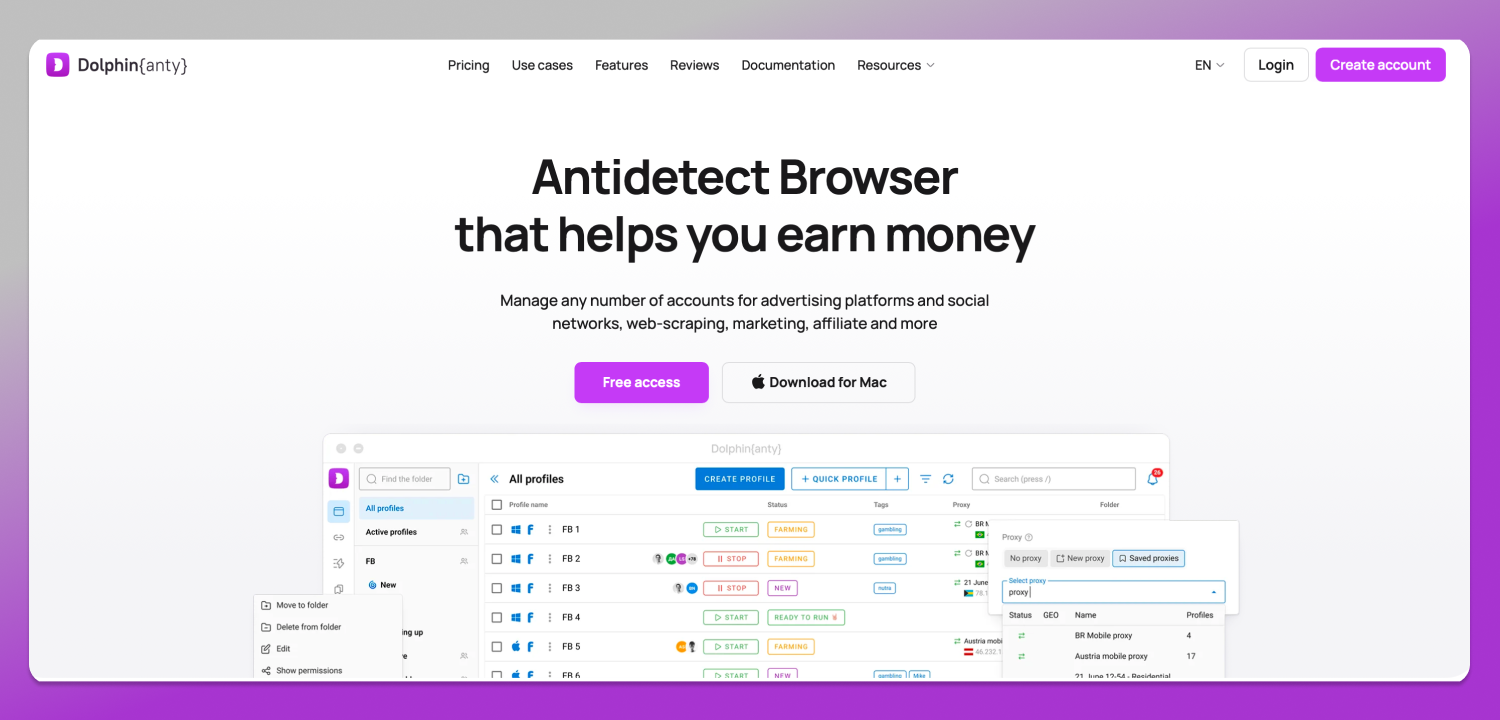
When working with a large number of accounts, launch speed becomes one of the key factors. In Dolphin Anty the “Quick Profile” feature lets you create a profile in one click without having to configure the fingerprint manually.
There is also the standard profile creation option with full digital fingerprint configuration: operating system, User-Agent, WebGL, Canvas, Client Hints, screen resolution, language, time zone and other parameters.
When managing a large number of profiles in Dolphin Anty, you can use tags, statuses, notes, extensions, bookmarks and startup pages. This helps you find the right accounts faster and understand the current status of each profile.
Network Environment is the First Antifraud Trigger
Each ad profile should have a 🔗 proxy assigned to it. With a regular browser constantly changing IPs is problematic. In Dolphin Anty you can do this directly when creating a profile, assign proxies later in a dedicated section or import them in bulk.
When adding proxies to profiles, it’s better ☝️ not to use the same proxy for multiple accounts. Instead, stick to the “one profile – one proxy” principle to avoid creating unnecessary links between accounts.
It’s also important to choose reliable providers and make sure the location matches. For example, if an account is used to work with a specific GEO, an IP address from another region can trigger a review.
It’s also worth paying attention to the IP address history. Cheap solutions have most likely already ended up on blacklists and spam databases, which can create problems even when the profile itself is configured correctly.
Affiliate Marketing is Impossible without a Team
Affiliate marketing involves several areas: farming and warming up accounts, testing setups, launching campaigns, allocating budgets and so on. 🙅 Doing all of this alone is practically impossible. At the same time, in a team setup, uncontrolled sharing of logins and passwords creates risks. Dolphin Anty, for example, has functionality that allows you to assign access permissions and share profiles and proxies with other team members.
There are 🛠 automation tools for warming up accounts. For example, Cookie Robot visits websites and builds up cookies automatically, while Scenarios let you configure sequences of actions for specific tasks. You can set the order of actions and add time delays between them to make them look more like human behavior.
Sometimes Less is More
There’s another thing that’s especially easy to see from the perspective of an affiliate network.
👨💻 The team with the biggest volume doesn’t always generate the most profit.
Sometimes it’s the other way around.
A small team carefully works with two or three GEOs, constantly refreshes its creatives, closely monitors the stats and ends up making more money than teams trying to cover half the world at once.
Chasing volume doesn’t always translate into higher profits.
Today’s Manager is More than Someone who Provides Offers
In the past, communication often looked simple:
– Do you have a new offer?
– Yes.
Today, good teams ask completely 🕵 different questions.
- Which category is gaining momentum right now?
- Where has competition increased?
- Which GEOs have started to decline?
- Which products are showing better performance?
- Which approaches are becoming more common in the market?
This kind of information can save you from dozens of failed launches.
What We Recommend to Those Working with Nutra Today
If we boil down everything we’ve observed over the past year into a few simple takeaways, the list would look something like this:
- Don’t try to find universal setups that work for every country;
- Adapt your approach to the specific GEO instead of simply translating the copy;
- Don’t be afraid to refresh creatives more often – audiences get tired faster than you might think;
- Test different approaches and try launching VSL funnels;
- Don’t draw conclusions based on the first sales; look at the bigger picture;
- Most importantly, stay in touch with your affiliate network. Sometimes one tip from a manager can save more money than a week of testing on your own.
And don’t forget about the technical side of things. When working with a large number of accounts, keeping traffic running without interruptions becomes just as important as choosing the right offer or creative. Proper organization of profiles and proxies, along with the use of automation, helps you adapt to market changes faster.