
Paid vs organic traffic is the first split anyone looking for visitors online has to understand. 💲 Paid traffic is any visitor who reaches you through an ad someone bought; 🌱 organic traffic is any visitor who reaches you without that click being paid for. That is the whole difference, and the rest of this guide explains what it changes in cost, timing, and predictability.
Neither is better than the other: almost every healthy operation runs both at once.
What traffic is and why the source matters
Traffic is the volume of people arriving at a digital destination of yours: a website, an online store, a social media profile, or a landing page. The number alone says little; what gives it meaning is the source. Someone who searched for your brand on Google already knew who you are; someone who saw an ad in a feed did not.
What organic traffic is
Organic traffic is the visitor who arrives without a direct payment for that click. Nobody bought the placement: the person found you in an unpaid search result, in a post delivered to followers, or through a link on another site.
Where organic traffic comes from
The most common sources are unpaid search, unsponsored social media posts, spontaneous links from other sites, and direct visits. In analytics reports these channels show up separately, but they all share the same trait: the click was not bought.
What organic charges instead of money
Organic is not free: it charges in time and work. A page has to be written, published, and indexed, and then earn relevance before it ranks well. In exchange, the visits you earn keep coming afterward, with no cost per click.
What paid traffic is
Paid traffic is the visitor who arrives through ads: you pay to appear in front of a chosen audience, in search results, in social media feeds, or before videos. The visits start with the campaign and end with the budget.
CPC, CPM, and CPA: how you are billed
- CPC (cost per click): you pay each time someone clicks the ad;
- CPM (cost per thousand impressions): you pay for every thousand times the ad is shown, click or no click;
- CPA (cost per acquisition): you pay when the click produces a defined action, such as a sale or a sign-up.
Why there is an auction behind the price
You are not buying a fixed slot. For every impression the platform runs an auction among advertisers competing for that same person, and the outcome combines the bid amount with the ad’s relevance. That is why two advertisers can pay different amounts for the same click.
Paid vs organic traffic: a direct comparison
| Criterion | Organic | Paid |
| Cost | No charge per click | Per click, impression, or action |
| Speed | Months to build ranking | Results on day one |
| Durability | Pays off without new spending | Stops with the budget |
| Scale | Limited by content output | Grows with more budget |
| Audience | Indirect control, through content | Direct targeting |
Other traffic types that show up in reports
Analytics tools also split traffic by the technical source of the visit, without replacing the paid-versus-organic divide.
Direct, referral, social, and email
- Direct: people who type the address or use a bookmark;
- Referral: people arriving through a link on another site;
- Organic social: visits coming from unsponsored posts;
- Paid social: visits coming from social media ads;
- Email: clicks coming from campaigns sent to your list.
Myths that get in the way of beginners
The first is believing organic is free: the cost exists, it is simply not charged per click. The second is treating paid traffic as wasted money, when it is rented attention and makes sense whenever the math works.
How paid and organic work together in practice
The most common path is using paid to quickly validate whether an offer interests anyone, and organic to build the base that keeps bringing visitors later. What you learn from ad copy becomes content topics.
When paid traffic becomes a multi-account operation
Anyone buying traffic at scale rarely works with a single ad account. Keeping accounts separated by client or by offer is routine, and a suspension on one of them cannot stop the rest. The risk appears when all of them are opened from the same browser: the platform links the accounts by fingerprint and the ban spreads.
Dolphin Anty: one isolated profile per ad account
🚀 Dolphin Anty is an antidetect browser built for that scenario. Each account gets its own profile, with a fingerprint generated across more than 20 parameters, plus isolated cookies and proxy. To the platform, each profile looks like a different device, and one account’s history is not read as the history of the others.
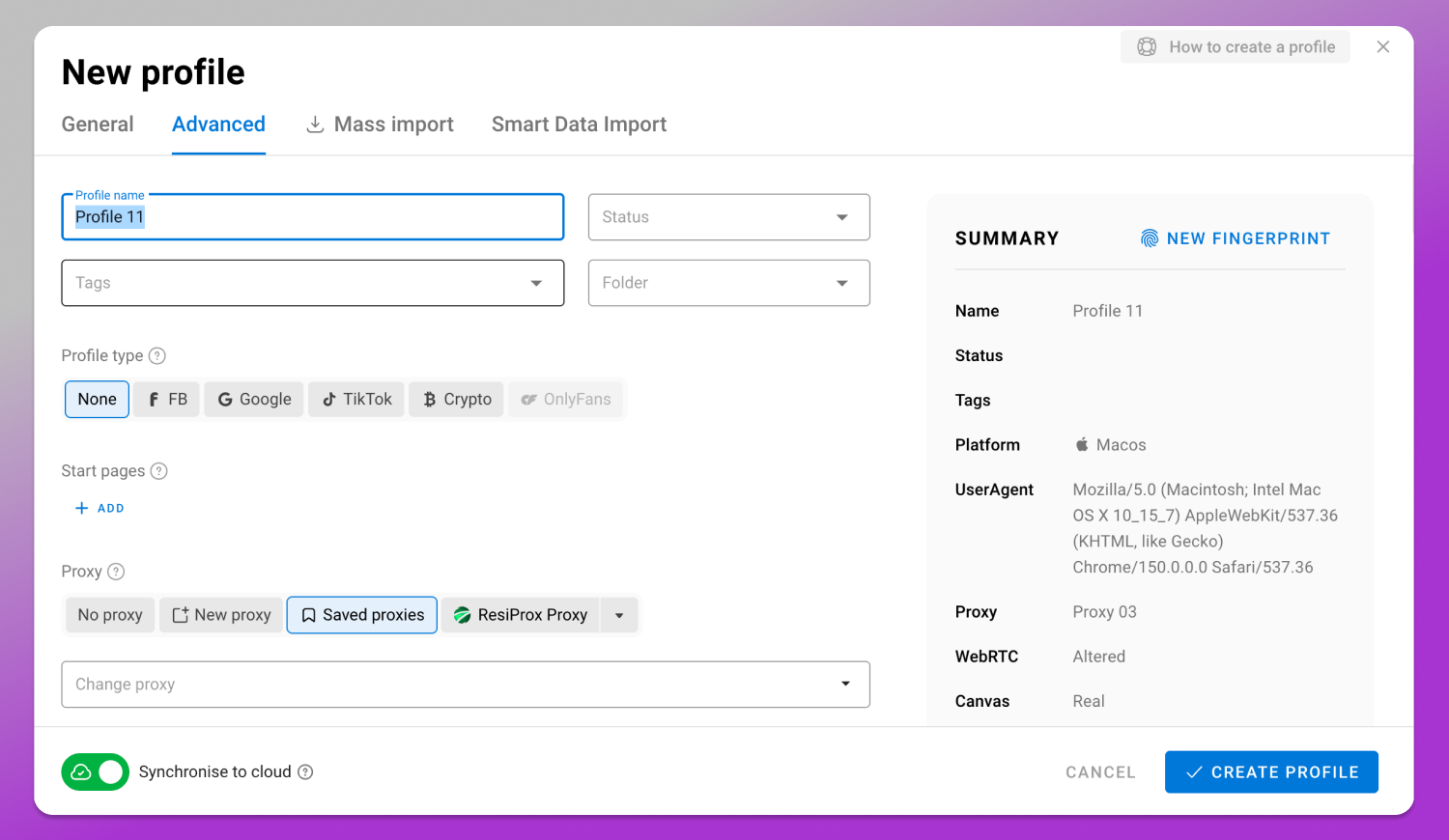
For teams, there is access management with per-user permissions, and profile creation can be automated through the API as volume grows. Signing up gives you 5 free profiles, no card required — enough to separate your first operations before scaling.
Frequently asked questions
What is the main difference between paid traffic and organic traffic?
Paid traffic has a payment tied directly to the click, the impression, or the conversion, and results start along with the campaign. Organic traffic carries no charge per visit, but the ranking has to be earned and takes considerably longer to appear.
Is organic traffic really free?
No. It has no cost per click, which is different from having no cost. Producing content, optimizing pages, staying consistent on social media, and waiting out the maturation period are real investments, paid in working hours rather than media budget.
What do CPC, CPM, and CPA mean?
They are ad billing models. CPC charges for each click received, CPM charges for every thousand impressions, and CPA charges only when the click produces the agreed action, such as a sale or a sign-up. The choice changes what the platform optimizes for.
Are direct and referral traffic paid or organic?
Neither involves paying for the click, so both sit on the organic side of the classification. Keep in mind that they are channels separate from organic search: they appear on their own lines in reports and grow for quite different reasons.
Do I have to choose between paid traffic and organic traffic?
No, and the choice is rarely exclusive. The usual approach is to start with whatever the moment demands, paid when you need a fast answer and organic when you can wait, then keep both running as soon as you can track each one.
Conclusion
Paid traffic buys attention now and stops with the budget; organic traffic takes a while to arrive and keeps paying off afterward. Once the difference is clear, the useful question is no longer which is better, but how much time you have to win the next visitor.