
Choosing a paid traffic course is now harder than learning the material: supply has grown, and so has the noise. Ads promise guaranteed income or a media buyer job in 30 days, but almost none explain what separates a solid course from an empty promise. This guide doesn’t name a course: it collects the criteria that decide the purchase — who teaches it, how current it is, what support exists, and what the refund policy says — so you can evaluate any of them before you pay.
Why “the best course” isn’t a universal answer
There is no single best course: what works for someone who has never launched a campaign is far too basic for someone who has managed accounts for years. Before comparing prices, settle two questions.
Define your level and your goal
A beginner has not yet set up a pixel or published an ad; an intermediate has run campaigns and wants optimization, creative, and measurement; an advanced buyer is after account structure, attribution, and scaling. Buying above or below your own level is 💳 the costliest mistake. Then comes the goal: serving clients calls for proposals, contracts, reporting, and managing several accounts; advertising your own business calls for offer, creative, and measurement inside your own funnel. Anyone aiming at traffic management for clients is really looking for a traffic manager course, with a sales module and a client-service routine.
Core criteria for evaluating paid traffic courses
With that settled, three points separate a good course from a well-produced storefront.
Who’s teaching, and with what verifiable credibility
Look for concrete evidence of results: detailed case studies from real clients and recognition in the paid media industry. Revenue screenshots don’t count, because they’re easy to fake. People actively managing accounts teach current practice; people who only teach repeat what used to work.
Updates, practice, and support
Ad platforms change policies and formats often, and a course recorded three years ago with no revisions may teach outdated practice or practice that now breaks platform rules. Check the last update date and whether updates are included in the price. Favor material with exercises, templates, and real account teardowns, and value a community or mentorship: a beginner’s questions are specific to their own account.
Refund policy and cooling-off rights
Here the US is a genuine outlier compared to Brazil and most of Latin America: there is no general federal right to cancel an online purchase in the US. The FTC’s Cooling-Off Rule gives buyers three business days to cancel, but only for sales made in person, away from the seller’s regular place of business — think door-to-door sales, trade shows, or hotel-room presentations. It explicitly excludes purchases made entirely online, by phone, or by mail, which covers the vast majority of paid traffic courses. Some states layer on their own consumer-protection rules for specific contract types, but there’s no blanket right to a refund just because you changed your mind. In practice, this makes the seller’s own written refund policy the only real protection you have — read it before paying, not after, and treat a course with no stated refund policy as a red flag rather than an oversight. A guarantee longer than a few days is a real differentiator precisely because nothing in federal law requires it.
Red flags to check before buying
📣 Certain patterns show up repeatedly in weak courses and in scams disguised as courses:
- Promises of guaranteed income — paid traffic involves real investment and real risk, and no serious course guarantees returns.
- Artificial urgency, with limited seats and countdown timers that force a decision with no time to research.
- No sample content and no open lesson before purchase.
- Generic testimonials, with no full name, verifiable profile, or context for the result.
- Vague scope, with no syllabus or module list before payment.
Free, official options to start with
Before investing, 📌 explore the free official certifications from the platforms themselves, which cover the fundamentals that generic paid courses repackage:
- Meta Blueprint, Meta’s official certification for Facebook and Instagram ads;
- Google Skillshop, Google’s official Ads training, with search, display, and video tracks;
- Public small-business training programs in your region, which frequently include digital marketing at no cost.
What paid traffic courses cost and the total cost of entry
Pricing varies by depth, support, and instructor reputation. As a rough reference for the US market: single-platform introductory courses run about $15 to $75 (Udemy or Coursera project-style courses on just Google Ads or just Meta Ads, for instance); structured multi-month certificates run roughly $100 to $300 (Coursera Specializations or professional certificates, often billed monthly at $39–$49); and intensive or mentorship-driven programs run $300 to $1,000+, scaling with live coaching, real account teardowns, and job-placement support. Official platform certifications sit outside that range: Meta Blueprint’s learning material is free, with exam fees around $99–$150, and Google Skillshop is entirely free.
Compare the price against what the course delivers: hours of content, support, included updates, and a student community. A pricier course isn’t always better; what matters is the gap between what you already know and what it adds.
Factor in the cost of practicing, too: you’ll need media budget, and accepted payment methods vary by market. In Brazil, Google Ads accepts Pix, credit cards, and alternative cards but not boleto, while Meta Ads accepts Boleto Bancário and PIX.
After the course: running multiple ad accounts without crossing trails
Learning paid traffic means testing real campaigns, almost always across more than one account: different clients or niches under test. Keeping each account in an isolated browser prevents Meta and Google from linking distinct accounts through the same technical trail.
What Dolphin Anty solves
🚀 Dolphin Anty is an antidetect browser built for people operating many accounts at once. Each profile gets its own fingerprint, generated across more than 20 parameters, plus isolated proxy and cookies. In practice, client A’s account shares no browser signal with client B’s account on the same machine.
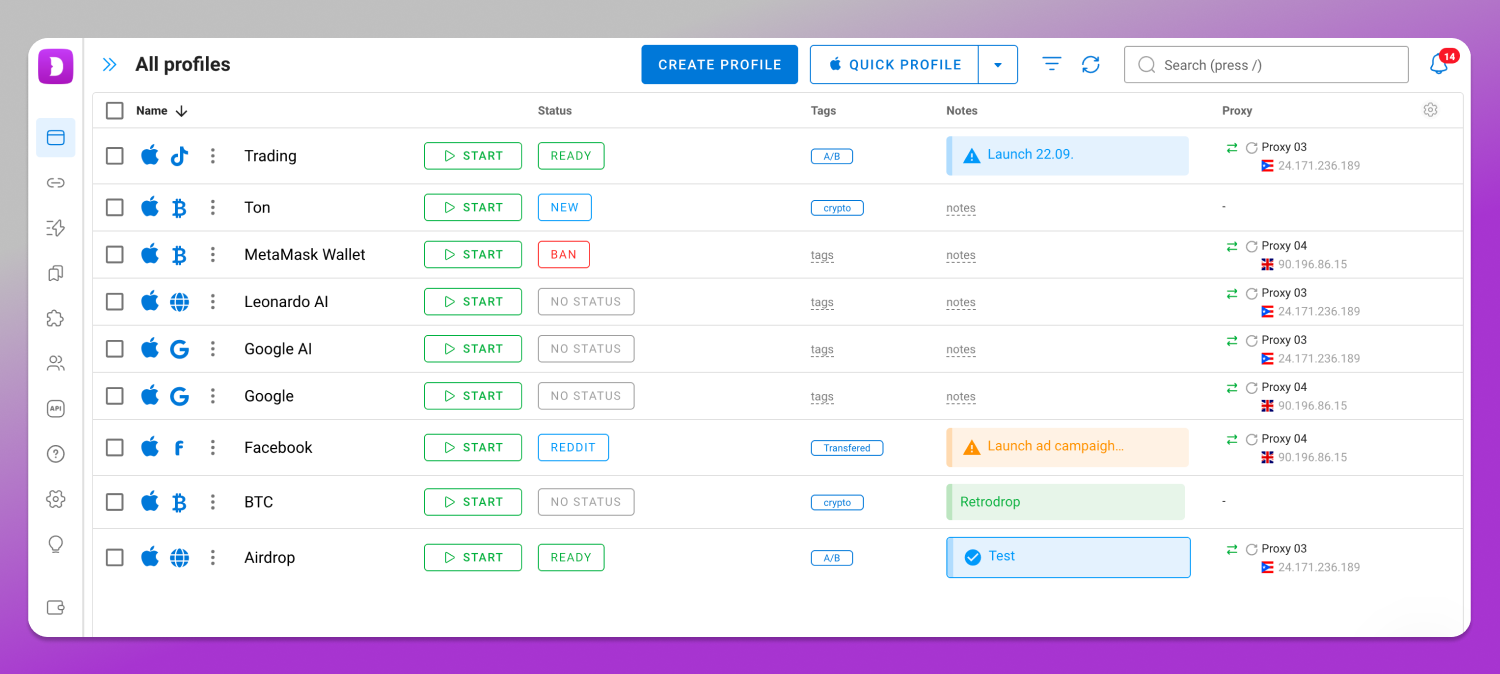
For anyone leaving a course and starting to take on clients, the difference shows up in the organization: team management with per-user permissions, so a profile can be handed over without sending passwords by chat, and API automation. Signup includes 🆓 5 free profiles, no card required.
Profile management tools: how to compare
The factual comparison usually looks like this:
- 🔝 Dolphin Anty— the most complete option for anyone managing several accounts: its own fingerprint per profile across more than 20 parameters, isolated proxy and cookies, per-user permissions, and API automation. Plans: Free $0 (5 profiles), Starter $10/month (20 profiles), Base $89/month (100 profiles), Team $159/month (300 profiles), Enterprise $299/month (1,000 profiles), and Custom with unlimited profiles on request. Runs on Windows 64-bit, macOS (Intel and M-series chips), and Linux (AppImage, .deb, .rpm).
- Multilogin — a known alternative in the same segment. Plans: Free forever with 5 profiles deleted after 7 days, Pro $11/month (10 profiles) or $85/year, and Business starting at $89/month (300 profiles). Requirements: Windows 10+, macOS 14 Sonoma+, or Linux Ubuntu 22+, 64-bit only, at least 4 GB of RAM and 1 GB of disk; Apple Silicon M1–M4 supported, Windows on ARM not supported.
Frequently asked questions
Is a paid course worth it when free certifications exist?
It depends on your level. Official certifications cover the fundamentals and basic tool operation well. A paid course earns its price when it delivers what those don’t: offer strategy, real account analysis, support for account-specific questions, and how to serve clients.
How long does it take to learn paid traffic?
Watching the lessons takes a few weeks; becoming competent takes campaign cycles. Real learning comes from launching ads, reading results, and adjusting, which depends on the time and budget you have for consecutive tests, not on how long the course runs.
Do I need media budget to take the course?
To watch it, no. To actually learn, yes: without live campaigns you follow theory without facing the decisions practice demands. Set aside an amount you can lose without harm, separate from the course price, and start with a single platform.
Does a paid traffic course guarantee a job or clients?
No, and any promise along those lines is a red flag. A course delivers method and reference points; getting hired depends on portfolio, demonstrable results, and relationships. People who land first clients usually start with small projects, their own or from people they know.
Can I cancel the purchase if the course isn’t what was promised?
Not by federal right, in most cases. Unlike Brazil or many other countries, the US has no general legal cooling-off period for online purchases — the FTC’s Cooling-Off Rule only covers in-person sales away from the seller’s regular business location, which excludes nearly all online courses. Your protection is whatever refund policy the seller states in writing, plus any state-level consumer protection that might apply to the specific contract type. Read that policy before paying, put any cancellation request in writing, and if you paid through a course platform, file the request there too.
Conclusion
There’s no universally best course: there’s the right course for your level and your goal, taught by someone verifiable, with current content and real support. Before investing, test the free official certifications, set aside a minimum media budget, and organize the accounts you’ll manage.
Read next: How to do paid traffic from scratch · Paid media manager: what they do