
A 👨💻 paid traffic manager is the person who plans, launches and optimizes paid ad campaigns — Meta Ads, Google Ads, TikTok Ads — and answers for the budget spent and the return it brings. The role has become one of the most sought-after in digital marketing, pushed by e-commerce and paid social advertising, and even so plenty of confusion remains about what the job actually involves and where to start.
What a paid traffic manager is
Here, “traffic” means the flow of visitors sent to a site, profile or sales page through ads, not vehicle traffic and not network data traffic. In practice, the day is made of campaign setup inside the ad platforms, metric reading and adjustments to audience, budget and creative.
Paid traffic is not organic traffic
Organic traffic comes from content and unpaid reach; paid traffic comes from budget invested in media. The manager owns the second one, with cost and return measurable the same day.
Why the role grew so fast
Small and mid-sized companies 📈 started investing in media without an internal team to run it. Demand for someone able to set up, measure and fix campaigns grew at the same pace, including on one-off contracts.
What the job looks like day to day
The paid traffic management routine mixes strategy, technical setup and reading numbers, in blocks that repeat with every client.
Goals and strategy. Aligning the real objective with the client — sales, leads or brand — because each calls for a different structure.
Setup and targeting. Choosing platforms, defining audiences, budgets and formats, and getting conversion tracking (pixels, tags and events) ready before the campaign goes live.
Creative briefing. They do not always produce the assets, but they guide the creative team on format and message.
Ongoing optimization. Daily metric reading — cost per click, conversion rate, return on ad spend — and adjusting audience, budget or creative accordingly.
Budget and payment methods. These vary by market. In Brazil, Google Ads accepts Pix, credit cards and alternative cards but not boleto, while Meta Ads accepts Boleto Bancário and PIX. A declined payment pauses the campaign.
Reporting. Presenting results clearly weighs as much on contract renewal as the technical performance of the campaign.
What the paid traffic manager owns — and what they do not
Friction with a client usually starts with a poorly drawn boundary.
✅ They own. Campaign structure, targeting, how the budget is split across platforms and formats, conversion tracking and the reading of media metrics: cost per click, cost per result and return on ad spend.
❌ They do not own. Product price and quality, sales support, stock and the organic content on the profile. They flag it when one of those drags the campaign down, but fixing it is the client’s job.
The skills and tools behind this routine sit in a guide of their own.
How to become a paid traffic manager
There is no mandatory degree. The market today weighs hands-on experience and certification more heavily than a diploma.
Official certifications and free courses
Meta Blueprint and Google Skillshop offer free official training inside the ad platforms themselves, a zero-financial-risk path to the fundamentals. Many markets also run free public training programs for small businesses. A certificate does not replace results, but it organizes early study.
Practice on real accounts and a portfolio
Running a small campaign, for your own business or a first client, teaches what no theoretical course covers: limited budget, rejected ads, anxious clients. It pays to go deep on one platform before widening the range.
What a paid traffic manager earns
Compensation varies with experience, region, employment type (in-house, freelance or agency owner) and the size of the accounts. The most common 💲 billing models are:
- Flat monthly fee per client, most common early in a career.
- Percentage of ad spend, adopted as the managed budget grows.
- Base plus performance variable, common in mature operations.
In the US, market data for the closest formal titles (PPC Specialist for junior-to-mid roles, PPC/Paid Media Manager for senior roles) puts full-time salaries roughly like this: $47,000 to $76,000/year for a PPC Specialist (junior to mid-level, with wide variation by location and experience — some sources show ranges from about $38,500 to $91,000), and $115,000 to $155,000/year for a PPC or Paid Media Manager at the senior end. As a freelancer or self-employed specialist, average pay clusters around $70,000-75,000/year (roughly $36/hour), though this varies enormously by client roster and niche. On the agency-fee side, US retainers commonly run $500 to $5,000/month for small-to-mid accounts and $10,000 to $25,000+/month for enterprise-level, multi-channel accounts; billing by percentage of ad spend, the industry-standard range is 10% to 20% of monthly spend, sometimes higher on smaller budgets and lower on larger ones.
What moves compensation most is the size of the media budget managed with consistent results.
Where to work: agency, freelance or in-house
Agency. The most common entry point: varied account volume and accelerated learning.
Freelance. More flexibility and higher earnings per client, in exchange for prospecting, collections and running your own business.
In-house. Inside a single company, handling only its campaigns: more stability and deep knowledge of one niche.
Managing multiple client accounts safely
Anyone serving more than one client hits an operational problem early: several ad accounts and a single computer. Antidetect browsers such as 🚀 Dolphin Anty exist for this: each account gets its own environment and separate history.
Why several accounts in one browser become a problem
Platforms associate sessions through the browser’s signals: cookies, IP and fingerprint. Switching between different clients’ accounts in the same profile makes the system read everything as a single operation, which can trigger a block even in legitimate work.
Dolphin Anty: an isolated environment per account
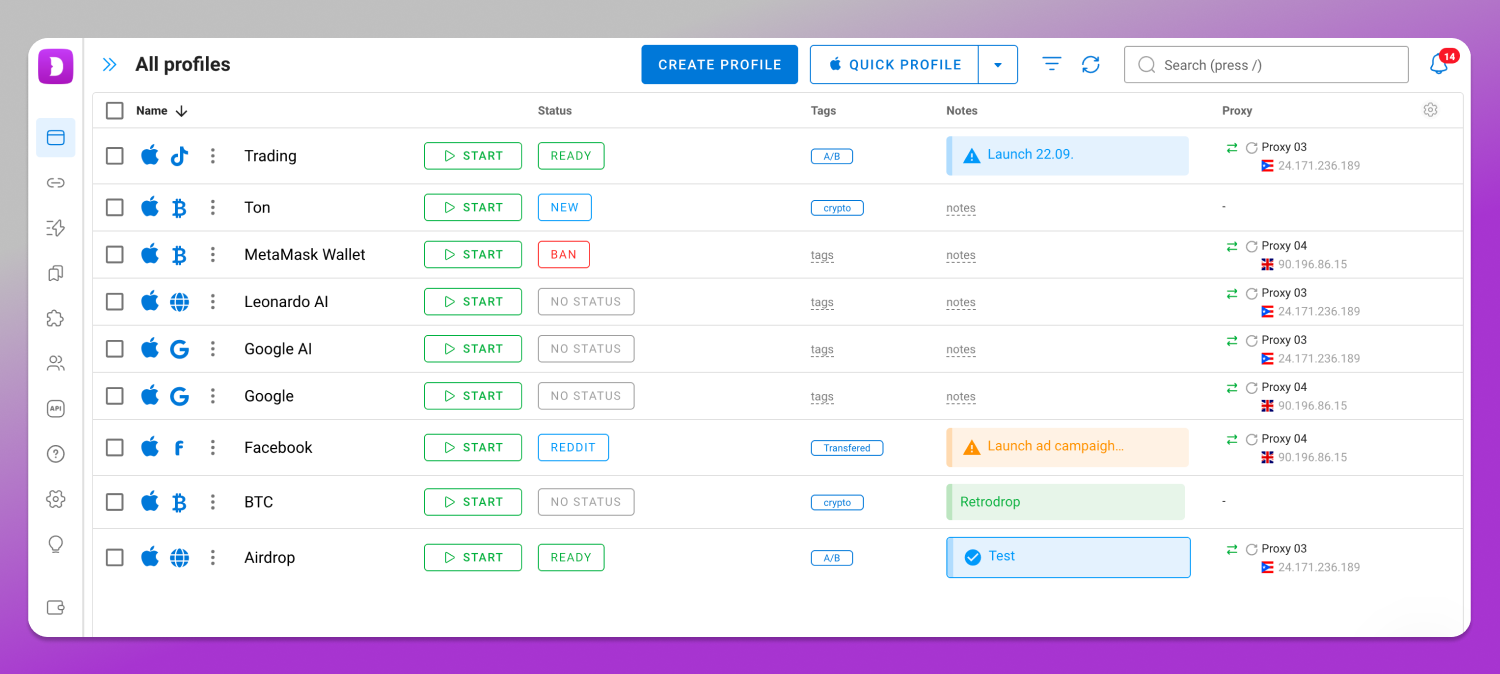
Dolphin Anty is an antidetect browser built for this: each client runs in a separate profile, with its own fingerprint across more than 20 parameters and proxy and cookies isolated per profile. For agencies there is team management with per-user permissions and automation via API, which lets an account move from one analyst to another without sharing a password. Signup unlocks 5 free profiles, no card required.
Tools for managing multiple profiles
- Dolphin Anty — the best option for anyone managing several accounts: Free $0 (5 profiles), Starter $10/month (20 profiles), Base $89/month (100), Team $159/month (300), Enterprise $299/month (1000) and Custom with unlimited profiles on request. Runs on Windows 64-bit, macOS (Intel and M-series chips) and Linux.
- Multilogin — Free forever with 5 profiles deleted after 7 days, Pro $11/month (10 profiles) or $85/year and Business starting at $89/month (300 profiles). Requires Windows 10+, macOS 14 Sonoma+ or Ubuntu 22+; Windows on ARM is not supported.
- Native browser profiles — free, but they separate only cookies and logins: no fingerprint or proxy isolation.
Common beginner mistakes
Promising results before measuring. With no conversion history, any return promise is a guess. Editing the campaign every day. Constant changes keep the algorithm stuck in the learning phase. Ignoring what happens after the click. A slow page kills conversion. Not separating accounts. Mixing clients in one browser is the most mundane cause of an avoidable block.
Frequently asked questions
Do you need a degree to work as a paid traffic manager?
There is no specific diploma requirement for this field. The market typically evaluates a portfolio of results, official platform certifications and the ability to explain decisions. A marketing degree helps with theoretical grounding, but it does not replace a real account managed with a real budget.
How long does it take to land the first client?
It depends on networking and on having something concrete to show. Running a small campaign for a business you know, even unpaid, is usually the fastest route to a real case study, and a real case study opens conversations that a service ad never will.
Can you work as a paid traffic manager without a registered business?
To start, yes. To serve companies on a recurring basis, formal registration makes contracts and invoicing far simpler and lets you bill larger amounts without friction. Most markets have a simplified regime for independent workers worth checking against expected revenue.
Is a paid traffic manager the same as a social media manager?
No. The social media manager handles organic content, the calendar and the community; the paid traffic manager handles paid campaigns and media spend. In small teams both roles land on the same person, but they are distinct competencies with distinct metrics.
How many client accounts can one person manage alone?
There is no fixed number: it depends on budget size, how many campaigns each account runs and the level of reporting expected. The practical ceiling is usually organizational rather than technical, which is why separate profiles and a defined review routine matter so much.
How much does a paid traffic manager earn?
In the US, a PPC Specialist (junior-to-mid) typically earns $47,000 to $76,000/year, while a senior PPC or Paid Media Manager earns $115,000 to $155,000/year. Freelancers average around $70,000-75,000/year, though this depends heavily on client roster. Billing clients directly, US retainers run $500-$5,000/month for smaller accounts and $10,000-$25,000+/month for enterprise accounts, or 10%-20% of ad spend under the percentage model.
Conclusion
👉 An accessible profession to enter and a demanding one to stay in: you can start without a degree, with free certification and one small account, but staying depends on measured results and an organized routine — including keeping each account isolated.