
Open any proxy provider’s price list and one line stands out: an IPv6 proxy costs a fraction of what the same provider charges for a single IPv4 address. The gap is real and it is not a trick. IPv6 has an address space so large that individual addresses carry almost no scarcity value, while IPv4 ran out years ago and now trades like a commodity. The catch sits elsewhere. An IPv6 address only reaches a site that answers over IPv6, so the protocol version is chosen by the target platform, not by the price tag. The difference shows in the address itself: a 32-bit IPv4 address looks like 203.0.113.10, a 128-bit IPv6 address looks like 2001:db8::1. Addresses in this article come from the ranges reserved for documentation, 2001:db8::/32 from RFC 3849 and 3fff::/20 added by RFC 9637, so nothing here is a live address belonging to anyone.
What Is an IPv6 Proxy?
An IPv6 proxy is a proxy server that presents an IPv6 address to the target site instead of a legacy IPv4 one. Everything else about it behaves the way any proxy server behaves: your browser or script connects to the proxy, the proxy makes the outbound request, and the site logs the proxy’s address.
The connection string is where people first trip. A normal IPv4 line reads 203.0.113.10:8080:login:password. With a v6 host, the address contains colons of its own, so it goes inside square brackets before the port separator: [2001:db8::1]:8080:login:password. Software that fails to bracket the host reads the address as a host plus a nonsense port and throws an error that says nothing useful.
The second thing to know is the unit of sale. Providers rarely hand out single IPv6 addresses. They assign a /64 subnet, a block containing more addresses than anyone will ever use, and you generate addresses inside it yourself. That is where the phrase “virtually endless supply of unique addresses” comes from, and also where a specific risk comes from, covered further down.
One disambiguation. Search this term and half the results describe an enterprise IPv6 gateway: a device at the network edge translating between IPv4 and IPv6 so an IPv4-only client can reach an IPv6-only service, or the reverse. That is network infrastructure. This article is about the other meaning, buying a pool of IPv6 addresses to route browser profiles, automation or web scraping through.
Why There Are “Infinite” IPv6 Addresses (And Why They’re Cheap)
IPv4 uses 32-bit addresses, capping the total space at roughly 4.3 billion. That stopped being enough during the 2010s, regional registries exhausted their free pools, and IPv4 addresses acquired a market price. Carriers papered over the shortage with NAT and CGNAT, which is why thousands of mobile subscribers share one public IPv4 address today.
IPv6 uses 128-bit addresses written in hexadecimal notation. The address space is large enough that handing a customer a /64, or even a /48 block, costs a provider nothing meaningful. A proxy seller pricing IPv6 at a fraction of IPv4 is pricing scarcity, not quality. Nothing about a cheap v6 address makes it cleaner, faster or better regarded by an anti-bot system. It comes from a supply that was never rationed.
Concrete per-address figures move constantly and differ by provider and by IP type, so compare live price lists on the day you buy rather than trusting a number printed in an article.
IPv6 Is Not a Proxy Type and Not a Connection Protocol
This is the confusion that costs people money. Three separate settings get collapsed into one word, and then someone buys “IPv6” expecting “residential.”
| Axis | Options | What it decides |
| IP version | IPv4, IPv6 | The format of the address the site sees, and whether the site can be reached at all |
| IP type | Datacenter, residential, ISP, mobile | Which ASN and network the address belongs to, and how a site reads its plausibility |
| Connection protocol | HTTP(S), SOCKS5 | How your client talks to the proxy, and what traffic it can carry |
These multiply. A residential IPv6 proxy exists. So does a datacenter IPv4 proxy over SOCKS5, and a mobile IPv4 proxy over HTTP. In a provider’s dashboard the three sit as three separate toggles on the same order form, a useful reminder that they are independent choices.
Practical consequence: if a platform distrusts datacenter ranges, switching from IPv4 to IPv6 solves nothing. You need a different IP type, possibly still on IPv4. If your scraper can’t speak the protocol your tooling expects, that is a SOCKS5 versus HTTP question, unrelated to address version.
IPv6 vs IPv4 Proxies: The Practical Differences
| Parameter | IPv4 proxy | IPv6 proxy |
| Address length and format | 32-bit, dotted decimal (203.0.113.10) | 128-bit, hexadecimal (2001:db8::1) |
| Pool size | Finite, exhausted, resold | Effectively unlimited |
| Price per address | High, driven by scarcity | Priced well below IPv4; compare live price lists |
| NAT in the path | Common, CGNAT widespread on mobile | Usually none, addresses are end-to-end |
| Unit of allocation | Single IP | /64 subnet, sometimes a /48 block |
| Site support | Universal | Only sites publishing an AAAA record |
| Geolocation targeting | City, ZIP and carrier filters widely offered | Country-level typical, ZIP and mobile-carrier filters usually unavailable on v6 blocks |
| Address history | Often reused, may carry someone else’s reputation | Usually fresh, no prior history |
| No AAAA record on target | Irrelevant | Connection fails or silently falls back to IPv4 |
| Concurrent sessions | Limited by how many IPs you bought | Limited mainly by the provider’s caps |
Does IPv6 Make the Connection Faster?
No. Several provider blogs sell “faster” as a headline benefit, and it does not hold. Speed is decided by the route, the capacity of the proxy node, how loaded it is, and how far traffic physically travels. IPv6 has a simpler header and no NAT step, which in a lab shaves a trivial amount of processing, invisible next to routing. In practice a v6 path can be slower, because v6 transit is less mature on some networks and traffic takes a longer route. Test latency on your own targets; don’t buy a protocol version expecting throughput.
Dual-Stack and What Happens When a Site Has No AAAA Record
Most modern operating systems run dual-stack: IPv4 and IPv6 enabled at once. DNS resolution returns an A record (IPv4), an AAAA record (IPv6), or both. With both present, the system picks a stack by its own preference rules, and IPv6 usually wins.
Now put a v6-only proxy in front of that. If the target publishes no AAAA record, there is no IPv6 endpoint to connect to. One of two things happens. Either the request fails with a timeout that looks like a dead proxy, or the system falls back to your real IPv4 connection and the request goes out around the proxy entirely. The second is the dangerous one, because it looks like success. A related pattern: a platform’s main site answering over IPv6 while its API endpoint does not, which breaks automation while manual browsing appears fine.
Advantages of IPv6 Proxies
Price per address is the obvious one, and for volume work it changes what is affordable. If a task needs hundreds of parallel identities and the target is indifferent to address reputation, IPv6 is where the budget goes further.
Pool size follows. With a /64 you are not rationing addresses, which makes rotation trivial. Rotating proxies on IPv6 often means cycling through addresses inside your own subnet, and a sticky session means pinning one address for as long as you need it. Concurrent sessions stop being the bottleneck. One caveat belongs right here rather than only in the risks section: changing address inside a single /64 changes the number, not the way you look to a system that groups by prefix. Against a defender working at /64 or /48 granularity, in-subnet rotation is cosmetic.
The addresses are also clean in a narrow sense: nobody used them before you. Secondary-market IPv4 addresses arrive with an unknown past, sometimes including a blacklist entry you inherit on day one. IPv6 addresses from a fresh block carry no such history.
Read that last point carefully. “No prior history” is not “good reputation.” The whole /64 can be registered to a hosting ASN, and an anti-fraud system that classifies by ASN labels every address in it as datacenter traffic on sight. You skipped the bad history and walked into a bad category.
The Downsides and Risks Nobody Puts on the Pricing Page
Coverage. Plenty of platforms still publish no AAAA record. No record, no connection, no amount of configuration fixes it.
Block granularity. Because addresses arrive in blocks, defenders block in blocks. One burned session can get the entire /64 flagged, and in aggressive cases a /48. On IPv4 you lose one address; on IPv6 you lose everything in a single order. That is the direct cost of the property making v6 cheap.
Visibility. IPv6 adoption among ordinary consumers is uneven between countries and between carriers inside one country. In a market where residential v6 is still uncommon, an incoming v6 address is itself an unusual signal, the opposite of blending in. Check current adoption for the market you actually target — public measurement projects publish it per country — before assuming a v6 address looks ordinary there.
Targeting limits. Providers state this plainly: “gIP, ASN, zip code, explicit IP, mobile carrier, and operating system targeting are not supported on IPv6 zones.” If your task depends on appearing to be in a specific metro area on a specific carrier, that alone rules v6 out.
Leaks. If your system keeps its v6 stack enabled while you route through an IPv4 proxy, your real IPv6 address can escape through WebRTC or DNS and appear alongside the proxy address. The site now has two addresses for one visitor, one of them yours.
To be explicit, since the marketing implies otherwise: IPv6 provides no anonymity and is not “cleaner” or more secure than IPv4. It is a different address space. Detectability is decided by IP type, IP reputation, browser fingerprint consistency and behavior, none of which change when the address format does.
When IPv6 Proxies Are Worth It, and When They Aren’t
The rule underneath every verdict below: where cost per address dominates and address reputation barely matters, IPv6 pays off. Where the platform grades reputation and expects you to look like a normal consumer connection, it usually does not.
| Task | Verdict | Why |
| Web scraping targets you control, or that answer over IPv6 | Yes | Volume is the constraint, cost per address is the lever, AAAA support is confirmable in advance |
| Crypto farming (airdrops, bounties, testnets) | Often yes | Endpoints are often developer-facing and more likely to accept v6; parallel identities matter more than consumer plausibility |
| Social platforms | Usually no | Trust scoring runs on reputation and consumer-typical connections; a datacenter-classified v6 block fits badly |
| Marketplaces (Amazon, eBay, Etsy, Shopify storefronts) | Usually no | Mature anti-fraud, real consequences on seller accounts, and v6 support in seller tooling that has to be tested per platform: query the AAAA record for the storefront and the API endpoints yourself before you buy |
| Ad accounts (Meta Ads, Google Ads, TikTok Shop) | No | Highest scrutiny, targeting precision matters, ZIP and carrier filters unavailable on v6 |
| E-commerce price and catalog analytics | Test first | Depends on the target’s AAAA support; cheap enough that a small trial answers it |
Multi-accounting is acceptable only where it does not breach the platform’s own rules. Meta Advertising Policies, the Amazon Seller Code of Conduct and the X Rules each set explicit limits on multiple accounts, and the account holder carries the consequences.
How to Check Before You Buy (5-Minute Test)
- Check the AAAA record for your target. Query the main domain and, separately, the API or login subdomain. They differ more often than you’d expect.
- Buy the smallest test allocation available, or use a trial if the provider offers one. Never open with an annual pool.
- Open the target through a browser profile on the test address and watch what happens: does the connection establish, does a CAPTCHA appear immediately, does login complete.
- Run the profile through checkers such as CreepJS, BrowserLeaks, Pixelscan and Whoer. What must match is specific: the IP the checker reports is the exact address in your profile settings, the country matches, the timezone matches the country, and the browser language fits.
- Check for a leak of your real IPv6. What must be absent is any second address in the WebRTC or DNS sections. One address everywhere, or the test failed.
On the free lists that rank for this topic: public IPv6 proxy lists are shared, unauthenticated and already flagged wherever they matter, which makes them fine for a connectivity smoke test and useless for anything with an account attached.
Using IPv6 Proxies With Dolphin Anty Profiles
In 🔥 Dolphin Anty a proxy attaches to a specific browser profile, not to the application as a whole. One profile holds one address plus its own fingerprint, timezone and language, and those travel together. That matters more on IPv6, because a v6 address from a hosting block plus a timezone that contradicts it gives a platform two mismatches to notice instead of one.
The order is fixed: create the profile, assign the proxy (bracketing the v6 host before the port), launch and verify through a checker, and only then log in. Verifying after login means testing with an account already exposed.
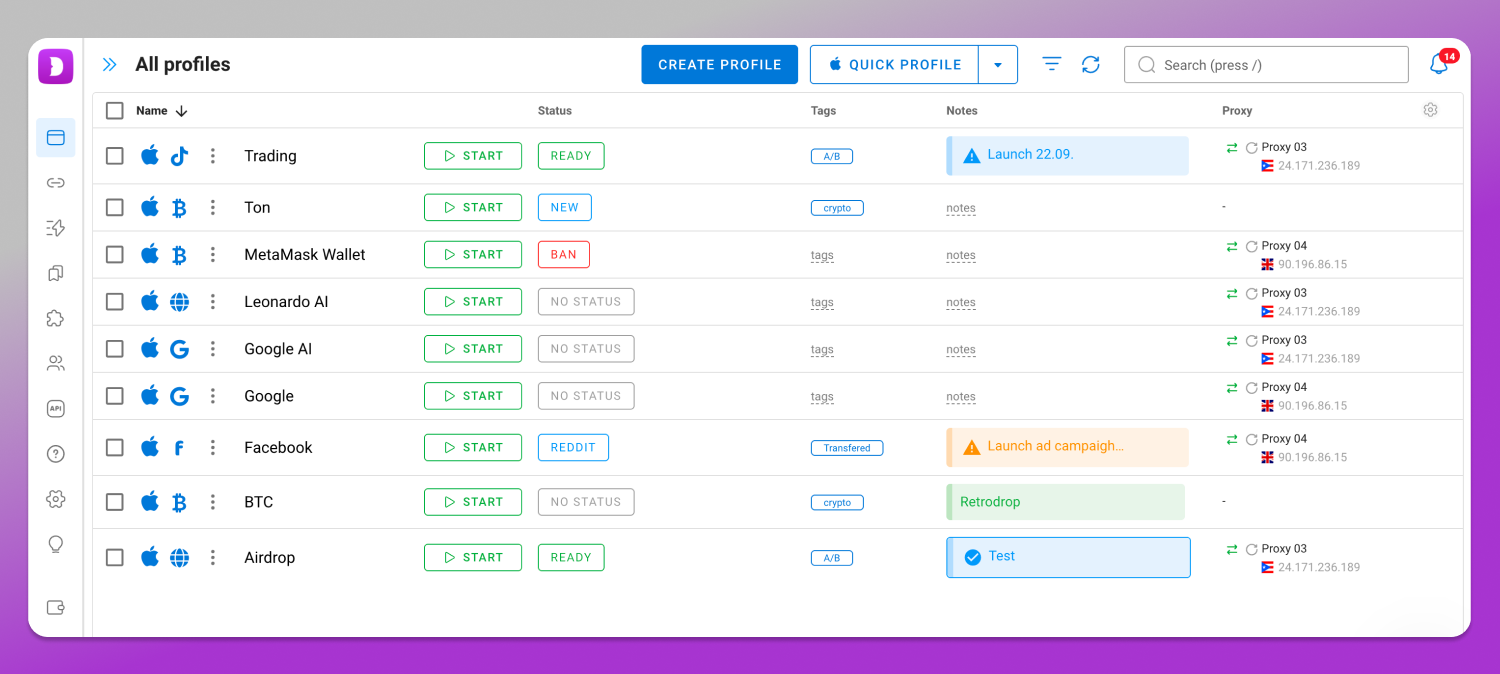
When you provision many profiles at once, proxy assignment is scriptable through the Remote API and the Local API; both the in-app flow and the API method are described in the Dolphin Anty documentation. The product is desktop software for Windows, macOS and Linux, with no mobile profiles. For profile limits and current plans, see the Dolphin Anty pricing page.
Frequently Asked Questions
Which proxy is best, IPv4 or IPv6?
IPv4, for most work, because it reaches everything and supports precise targeting. IPv6 wins on tasks that need many cheap addresses against targets confirmed to answer over IPv6.
Is there a downside to using IPv6?
Several: incomplete site support, blocks applied across a whole /64, no ZIP or carrier targeting, and in some markets a v6 address stands out as unusual rather than blending in.
Will IPv6 make my internet faster?
No. Speed comes from the route, the link and node load, not from the protocol version. Any provider selling IPv6 primarily on speed is overselling it.
Which VPN uses IPv6?
VPN support for IPv6 varies by provider, and it is a separate question from proxies. A VPN routes the whole machine through one tunnel; a proxy binds per browser profile, which is what multi-accounting needs.
Are free IPv6 proxy lists usable?
For checking whether a site responds over IPv6, yes. For anything involving an account, no.
Bottom Line
Pick the protocol version from the target, not the invoice. Query the AAAA record, test a few addresses through a real profile with checkers running, and decide from what you see. Where IPv6 works it saves real money at volume; where it doesn’t, no price makes up for connections that never complete. Keep the legal side in view too: multi-accounting is permissible only where it breaks neither platform rules nor applicable law, which means GDPR in the EU, UK GDPR in the United Kingdom, and CCPA/CPRA in California, according to where you and your data subjects actually are.