
Selling on Mercado Libre from abroad runs into three walls before the first listing goes live: legal presence and a tax ID in the country you sell into, local payouts and a way to get money out, and local logistics with customs clearance. Those are the barriers, in that order, and none of them is solved by opening more accounts.
Which brings up the thing most foreign sellers get wrong. Mercado Libre Global Selling is built around one international seller account selling into several Latin American countries, and the official positioning is explicit about that single account. So “a separate account per country” is not the design of the program. Separate accounts belong to different situations: different legal entities, genuinely different brands, or a local registration sitting alongside an international one.
Shopee is a different animal, with a sub-account system and a Latin American footprint that shrank to essentially one country. Here is how both work, what the account rules say (and where they say nothing), and how to run more than one storefront without gluing them together by accident.
How Selling on Mercado Libre From Abroad Actually Works
Global Selling is the main door for a foreign seller. The pitch: list once, reach buyers across several Latin American markets, get paid, and ship cross-border, without standing up a company in each country first. Mercado Libre is the region’s largest e-commerce platform, and the program’s own page names four destination markets: “Sell in Mexico, Brazil, Chile and Colombia with a single account.”
Access is the fuzzy part, and it is fuzzy because Mercado Libre does not describe it publicly. The official Global Selling pages do not say whether the program takes open self-registration or screens applications, which countries it accepts sellers from, what it costs to join or how long approval takes, and the widely repeated “invite-only” line traces back to secondary sources rather than to anything the company published. Treat it as unknown until you get an answer from the program itself.
On fulfillment, the platform describes three mechanics: international drop shipping, direct fulfillment by Mercado Libre, and a US fulfillment center. Three different cost and speed profiles, and picking the wrong one is the most common early mistake.
Requirements and Setup
What gets asked for, broadly: company identification, banking details capable of receiving payouts, and a tax identifier, either in the destination country or handled through the program or a partner of record.
Country by country, the requirements diverge sharply. Brazil, Mexico, Argentina, Colombia and Chile each run their own registration regime around their own tax identifier, and a document that satisfies one does nothing in the next. Whether a foreign seller has to hold that identifier directly, or obtains it through the program, is a question to put to Mercado Libre for the specific country you are targeting. Do not assume the Mexican path applies in Brazil.
One practical note on language. Buyer communication happens in Portuguese in Brazil and Spanish everywhere else, and response quality feeds seller metrics. Machine translation shows, and buyers notice.
Fulfillment, Shipping and Imports
The real choice is cross-border shipping versus local stock. Cross-border keeps working capital light and delivery slow. Local inventory, held under an Importer of Record arrangement where the seller has no local entity, flips both: money tied up in stock, delivery measured in days instead of weeks.
Delivery time feeds buyer expectations, Mercado Envíos handling, and how listings surface. A cross-border listing competing against a locally stocked one loses on the delivery estimate alone. Duties and import taxes land on top, and both the value at which they start and the point at which they are collected are set by the destination country and revised on its own schedule, so confirm them for the exact corridor before you price anything.
Multiple Seller Accounts on Mercado Libre: What the Rules Actually Say
The honest position: there is no detailed public English-language Mercado Libre policy on holding multiple seller accounts. Not a permissive one, not a restrictive one, and no published number of accounts either. The question is officially not specified in the documentation available to an English-reading seller.
What is documented is adjacent and useful: Mercado Libre publishes guidance on duplicated listings (the same item published more than once) as a practice to avoid. That is a listing rule, not an account rule, and conflating the two is how sellers talk themselves into a plan the platform never endorsed.
The contrast with global marketplaces is stark. Amazon’s Seller Code of Conduct and eBay’s Multiple account policy both address related and linked accounts in published, quotable terms. Mercado Libre’s English documentation does not. Less documentation is not permission. It means enforcement arrives without a public rulebook to argue against, which is a worse position for a seller.
And the load-bearing fact stays where it started: Global Selling exists so that one account sells into several countries. If the reason for a second account is “I want to sell in Mexico too,” the program already covers that.
Legitimate Reasons for a Second Storefront and the Honest Alternative
Separate accounts make sense in a short list of cases:
| Scenario | Does one account cover it? |
| Selling into a second LatAm country | Yes. That is what Global Selling is for. |
| Two distinct legal entities, separate books | No. Separate entity, separate account. |
| Two unrelated brands with different audiences | Usually yes, through categories and listing presentation. |
| Wholesale alongside retail | Depends on pricing model and invoicing; often one account with separate listing sets. |
| Local registration added next to the international account | Genuinely two accounts, and worth declaring rather than hiding. |
| Testing a new niche quietly | One account. A test does not justify a second identity. |
The honest alternative in most rows is the same: use categories, listing structure and brand presentation inside one account before you split. A second account permanently doubles the compliance surface, the payout plumbing and the operational risk, to solve a problem that listing hygiene usually solves.
Shopee: Sub-Accounts, Multiple Shops, and Why the Brazilian Case Is Different
Shopee documents its account model openly: a main account plus sub-accounts, managed through the Sub-account Platform with role-based permissions, and multi-shop chat management for operators handling several storefronts.
The distinction that causes bans: a sub-account is a person operating inside one shop, while a separate shop is a separate business identity. A team member with a sub-account login is not a second store, and a second store is not a permissions setting. Sellers who read a sub-account guide and conclude they can spin up parallel shops the same way find out the difference through enforcement.
Now the geography, which most English-language material silently skips. Almost every English guide on running multiple Shopee accounts is written about Southeast Asia: Malaysia, the Philippines, Thailand, Indonesia. Those are the markets with the seller-education articles, the tooling ecosystem, and the community threads. In Latin America the picture is narrower and it has moved: Brazil is Shopee’s core market in the region, Chile, Colombia and Mexico are closed, and Argentina, closed earlier, reopened in December 2025. Rules, seller programs and support structures from the SEA markets do not transfer to Shopee Brasil, and treating a Malaysian help article as policy for a Brazilian shop is a guess dressed as research.
How Marketplaces Link Accounts
Before the signal list, the disclaimer that matters: platforms do not publish their detection criteria. What follows is the general mechanics of how linked accounts get associated across e-commerce platforms, not a published Mercado Libre or Shopee rule.
The commonly discussed signals:
- Device and browser fingerprint: User-Agent, screen and hardware parameters, Canvas and WebGL rendering, installed fonts, time zone, language settings.
- Network: the IP address, and just as importantly the subnet and its reputation. Two stores on one home connection are two stores on one connection.
- Storage: cookies, local storage, session data carried between logins in one browser.
- Contact data: phone numbers and email addresses, including recycled ones.
- Financial profile: payout instrument, bank account, payment profile, tax identifier.
- Logistics: ship-from address, warehouse, return address.
- Content: listing templates, product photos, description boilerplate reused verbatim across stores.
The financial and tax layer is the strongest of these, and the least fixable after the fact.
What Happens When One Account Gets Restricted
A restriction rarely stays contained. Where an association is established, action extends to the accounts on the other end of it. Funds settlement pauses. Open orders still have to be fulfilled, and failing to fulfill them damages the metrics on whatever accounts survive. Refunds, claims and negative feedback land regardless of the seller’s view of the decision.
Do not plan around specific hold periods or appeal windows. Those vary by country and by violation type, and any number quoted from memory is a liability. Read them off the seller help for the country the account belongs to, at the moment the restriction lands.
Reputation Does Not Transfer
Mercado Libre runs a seller reputation system with visible levels, the MercadoLíder tiers of platinum, gold and silver, and that status affects listing visibility and shipping cost treatment. It is earned per account and it does not move. Opening a fresh account after a restriction restarts from nothing, in a marketplace where reputation drives conversion. Even setting the rules aside, that is a bad trade.
Buying, renting or reselling aged accounts with existing reputation is a rules violation on every major marketplace and transfers control of your revenue to someone who can reclaim it. Registering under a relative’s or an intermediary’s documents creates a legal and tax exposure in a jurisdiction where you have no standing to defend yourself.
Technical Isolation: One Storefront, One Environment
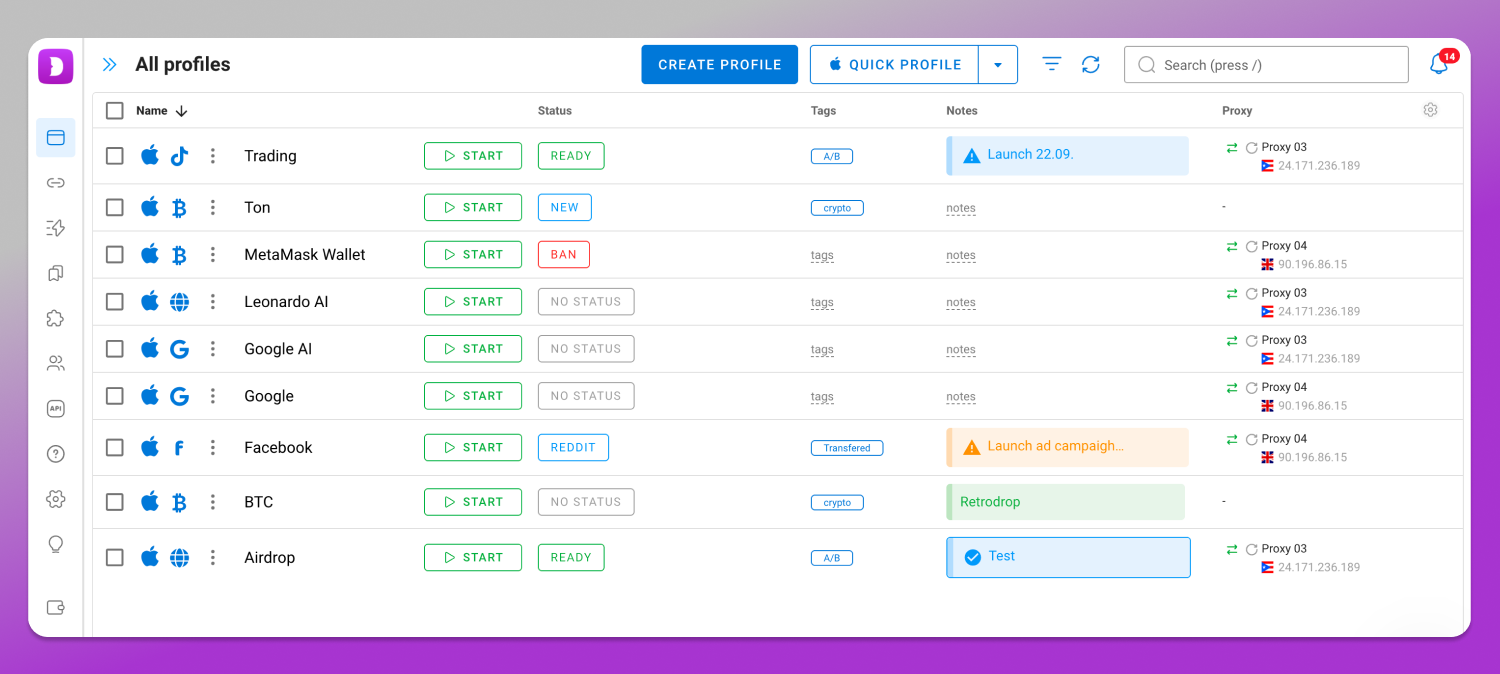
If you legitimately operate more than one storefront, each gets its own environment: one browser profile per store, with its own fingerprint, cookies and local storage, and a stable local IP in the country of sale. Contact and payout details stay separate too, within the limits of the law and the platform’s requirements.
That is where 🚀 Dolphin Anty fits. It is a desktop antidetect browser for Windows, macOS and Linux that keeps each storefront in an isolated profile with a separate fingerprint. That covers parameters including User-Agent, Canvas and WebGL, fonts, time zone, language, screen and hardware values, so two stores opened on one machine do not share a browser identity. Proxy assignment is per profile, so a Brazilian storefront works from a Brazilian IP and a Mexican one does not borrow it.
Two limits, stated plainly. Isolation reduces the risk of accounts being associated. It does not protect against bans, and no tool does: violate a policy on a clean profile and the account still goes. And a large share of seller work on both platforms happens in mobile apps. Dolphin Anty is desktop software for the web seller panel. It does not emulate a seller’s mobile app, and no Android or iOS profiles exist in the product.
Teams, Assistants and Agencies
The moment a VA or an agency touches your storefronts, password sharing stops being acceptable. Grant access at the profile level with role-based permissions, so an operator opens the store they are assigned and nothing else, and revoke it when the relationship ends without rotating credentials everywhere. Two features get mixed up here and they do different jobs. Synchronizer repeats the actions you perform in a master profile across the other profiles you have open, which is live multi-window control rather than a settings transfer. Cloud synchronization of profiles, cookies and extensions is a separate feature, available on paid plans, and that is the one that keeps a distributed team working from one environment per store instead of each person building their own.
For what team seats and profile capacity cost, check the current plans on the 📌 Dolphin Anty pricing page. The numbers move, and a figure written here would be stale by the time it matters.
Local Payments, Taxes and Documents
The same payout instrument across two accounts is the most direct association signal a seller can create. It is also the one sellers create first, because it is convenient.
Payment and tax infrastructure is national, not regional, and Brazilian mechanics do not exist in Spanish-speaking markets:
| Country | Payments | Tax and documents |
| Brazil | Mercado Pago, Pix, boleto | CNPJ / CPF, nota fiscal |
| Mexico | Mercado Pago, SPEI, cash payment at OXXO | RFC, SAT, CFDI |
| Argentina | Mercado Pago | CUIT, ARCA (ex-AFIP) registration, monotributo |
| Colombia | Mercado Pago, Nequi, PSE | RUT (Registro Unico Tributario), DIAN |
| Chile | Mercado Pago, Webpay (Transbank) | RUT (Rol Unico Tributario), SII registration |
Cash-based payments still matter in Mexico and Brazil, which shapes conversion and settlement timing. Selling commissions, Mercado Pago fees, payout schedules and withdrawal costs belong to official sources only: they are set per country and revised without notice, so build every margin calculation from the current fee page for that country rather than from a figure in an article.
Data protection runs on two tracks at once. As the seller, you sit under your own regime: GDPR in the EU, UK GDPR, or CCPA/CPRA in California. Your buyers’ data sits under theirs: Brazil’s LGPD (Lei 13.709/2018), Mexico’s LFPDPPP, Argentina’s Ley 25.326, Colombia’s Ley 1581 de 2012, Chile’s Ley 19.628 as reformed by Ley 21.719, and Peru’s Ley 29733. Multi-store operation does not dilute any of that.
Frequently Asked Questions
Can I have more than one seller account on Mercado Libre?
Officially not specified in Mercado Libre’s English documentation. No published policy either permits or prohibits it for international sellers, and no cap on seller accounts is published at all, which means enforcement is discretionary and you carry the risk.
Can I sell in several Latin American countries from one account?
Yes. That is precisely what Global Selling is built for: one international seller account, multiple LatAm markets.
Can I have a buyer account and a seller account?
Common practice, though neither platform publishes a rule on it. Keep them in separate browser environments if you want them treated as separate identities.
Can two accounts share one tax ID?
Shared tax identifiers link accounts about as directly as anything can. If two storefronts belong to one entity, they are one business to the tax authority and to the marketplace, whatever the login says.
Can I open a new account instead of a suspended one?
No. Evading a suspension violates marketplace rules on every platform discussed here, and the new account typically gets caught by the same association signals that identified the first. Appeal through the official process, fix what triggered it, and if the decision stands, accept it. Reputation does not carry over anyway.
Do Shopee sub-accounts count as separate accounts?
No. A sub-account is a permission level inside one shop, for staff. A separate shop is a separate business entity on the platform. Confusing the two is the single most common route to a suspension.
Does Shopee work across all of Latin America?
Not across all of it. Brazil is the core Latin American market, Argentina reopened in December 2025, and Chile, Colombia and Mexico are closed. English-language multi-account guides for Shopee almost always describe Southeast Asian markets, not these.
Start with the entry barriers, not the account count. Confirm your tax and payout position in the one country you actually want to sell in, pick a fulfillment model you can fund, and open a second storefront only when a second legal entity or a genuinely separate brand makes it necessary.