
If you want to manage multiple accounts without getting banned, start from the part most guides skip: on most large platforms, having several accounts is allowed. What gets punished is one person presenting themselves as several unrelated people, or one operator running accounts the platform has already tied together. Two different rules, two different outcomes.
This page is the index for that question: roughly twenty platforms, each with the policy document that governs the answer and the specific things that cause accounts to be linked there. It is written for people with a real reason to run more than one login: a seller with two storefronts, an agency holding ad accounts for five clients, a crypto user with separate wallets.
The failure mode looks like this. Three stores on one laptop, same browser, same home connection. One store gets restricted. Within a day, the other two follow. Nobody reported anything. The platform matched them.
Are Multiple Accounts Even Allowed?
Two prohibitions get confused constantly, and the confusion is expensive.
The first is a ban on quantity: exactly one account, full stop. This is rare, and it shows up mostly where the account is tied to a legal identity, a payout or scarce inventory.
The second is a ban on misrepresentation: several accounts are fine, using them to fake independent people, evade a prior enforcement action or multiply your share of something limited is not. That is the general rule across social networks, marketplaces and ad systems.
Explicitly permissive. Several consumer platforms ship multi-account switching as a product feature. Instagram lets you add accounts inside the app; Google and Outlook both support more than one mailbox in a single browser session. When the vendor builds the switcher, the vendor is not going to ban you for using it.
Conditional. The account is allowed if a stated condition holds. Amazon’s Seller Code of Conduct is the reference case: a second selling account is tied to a legitimate business need rather than to a preference. PayPal’s structure splits along account type instead of count, with one personal account and one business account treated as different things.
Restrictive. A handful prohibit additional accounts outright, usually where scarcity or resale is involved. Ticketmaster is the standing example: its Standard Purchase Policy is the document to read, and the one-user-one-account rule dates from October 2025, announced by Live Nation after the FTC sued the company in September 2025. It is a company commitment stated in a letter to US senators, not an order imposed by a regulator.
One more thing decides how much room you have: enforcement lands on the account type, not on the person. A restricted personal profile is an inconvenience. A restricted seller account with inventory in a fulfillment center and a pending disbursement is a business event.
The Three Signals That Link Your Accounts
Platforms do not need a confession. They need correlation, and they have three families of it. The mechanics below are the same everywhere. Only the thresholds and the punishments differ, which is exactly what the table further down records.
Device and Browser Fingerprint
Your browser answers a long list of questions before you type anything. User agent, screen resolution and color depth, installed fonts, CPU class, hardware concurrency, device memory, language list, time zone, canvas and WebGL output, audio stack behavior, media devices. Individually, none of these identify anyone. Together they narrow the field fast, and that is why they are worth controlling deliberately rather than leaving them to whichever machine you happen to work from.
Consistency is the part practitioners underestimate. A profile claiming macOS with a Windows font list is more suspicious than an ordinary duplicate. Contradiction reads as manipulation, sameness reads as one person, and you want neither.
Network and IP
A shared IP address is the crudest link and still the most common cause of a cluster ban. It reaches past the single address: accounts in the same /24 subnet, on the same datacenter ASN, or behind the same overused proxy pool get treated as neighbors.
Then there is the mismatch problem. A profile with a Berlin time zone and a German language header arriving from an IP that geolocates to Singapore is a contradiction visible in one request. WebRTC leaks add a second layer, exposing the real connection behind an otherwise clean proxy. Use a dedicated IP per account and keep its geolocation aligned with the rest of the profile.
Storage and Cookies
Cookies, localStorage, IndexedDB, service worker caches and saved sessions all carry identifiers that outlive a logout. Log out of account A and log into account B in the same browser and you have handed the platform a direct link. Cross-domain identifiers do the same at a distance: an advertising cookie set on one site travels with you, and single sign-on ties everything you touch back to one identity graph.
Behavior sits on top of all three. Identical posting times, recycled content, the same payment method, the same shipping address, the same recovery email across accounts. Those correlations you create yourself, and no browser setting undoes them.
Platform-by-Platform: What the Policy Says and What Gets You Linked
Read the table as a routing map. The middle column names the document that governs the answer, because policies change and secondhand summaries go stale silently. The right column is the operational part. Where a number or clause would be needed, the table carries a placeholder instead of a guess, resolved against the source document with the date it was checked. An invented limit is worse than a blank cell.
| Platform | Governing document (what the policy says) | What links accounts here | Full guide on this platform |
| Meta’s terms for personal accounts; one personal profile per person, with Pages, ad accounts and other business assets held under that profile instead of as extra profiles. | Fingerprint, IP, recovery email and phone reuse, friend graph overlap, shared Business Manager admins | — | |
| Meta’s terms for the app; running more than one account is supported and switching between them is built in, so the account boundary is the login, not the install. | Shared device and app install, linked phone number, cross-posting, same contact list | — | |
| TikTok | TikTok’s terms of service and community guidelines; more than one account is ordinary, and what is policed is reuse of one device and one verified identity rather than a count. | Device ID, IP, phone verification reuse, near-duplicate content | — |
| LinkedIn’s user agreement; the platform is built around one real-identity profile per person, so a duplicate profile is something to merge or close, not a second workspace. | Real-name matching, email and phone reuse, connection overlap, device and IP | — | |
| X | The X Rules on platform manipulation and spam; multiple accounts are permitted, overlapping or automated ones are not. | IP, fingerprint, cross-posting, reciprocal engagement between your own accounts | — |
| Reddit’s user agreement and content policy; alternate accounts are common, and the line is using them to manipulate votes or to come back after a ban. | Session data, IP, voting on your own submissions, writing style and schedule | — | |
| Pinterest Terms of Service and Community Guidelines; personal and business accounts are separate objects, and they can no longer be joined: “It’s no longer possible to link a personal account to a business account.” | Email reuse (one address per account), the claimed website (a site can be claimed by only one account), device and IP | Can You Have Multiple Pinterest Accounts? | |
| Snapchat | Snap Terms of Service and Community Guidelines. There is no account switcher in the app: a saved account appears on the login screen after you log out, and the Profile Switcher moves between Public Profiles inside one account, not between accounts. The web surface is limited, so a desktop browser profile covers only part of the workflow. | Device identifiers, phone number and email (only one unique email and/or number can be verified per account), contact graph | Can You Have Multiple Snapchat Accounts? |
| OnlyFans | OnlyFans’ terms of service and acceptable use policy; every account is tied to verified identity documents and payout details, and that binding, not a number, decides whether a second one is possible. | Identity verification documents, payout details, device and IP | — |
| Telegram | Telegram’s terms of service; the clients hold several numbers in one app, so the account boundary is the phone number rather than the device. | Phone number, device, contact list overlap | — |
| Discord | Discord’s terms of service and community guidelines; alternate accounts are allowed and no cap is published, ban evasion is not allowed. | Fingerprint, IP, shared email or phone, same servers from linked sessions | Can You Have Multiple Discord Accounts? |
| Amazon (selling) | Amazon’s selling policies and Seller Code of Conduct; a second selling account rests on a legitimate business need, so the case for it, not the preference, is what carries it. | Bank and tax identity, shipping address, device and IP, catalog overlap | — |
| eBay | eBay’s user agreement and its policy on multiple accounts; several accounts are permitted, no number is published, and each one needs its own email address. | Payout details, address, device and IP, listing similarity | eBay Suspended My Account: Linked-Account Suspensions |
| Mercado Libre | Mercado Libre Terms and Conditions and the seller policies for each country site; the help centre does not publish a numeric account limit | Tax and identity documents, Mercado Pago payout details, shipping origin, device and IP, listing overlap across country sites | Selling on Mercado Libre and Shopee From Abroad |
| Etsy | Etsy’s terms of use and seller policy; a shop is bound to the seller’s identity and bank details, and any second shop lives or dies by that policy rather than by a published count. | Bank details, address, device, listing and photo overlap | — |
| Shopify | Shopify’s terms of service and acceptable use policy; separate stores are a normal structure and, outside Plus, each store is its own subscription, so billing identity is the constraint. | Billing identity, payment gateway, staff accounts shared across stores | Can You Have Multiple Stores on Shopify? |
| TikTok Shop | TikTok Shop’s seller terms and Seller Code of Conduct; a shop is bound to a verified business registration and payout account, which is what governs whether a second one can exist. | Business registration, payout account, device, catalog duplication | — |
| PayPal | PayPal’s user agreement and acceptable use policy; the structure splits by type rather than by count, one personal account and one business account, treated differently. | Legal identity, bank and card reuse, address, device and IP | Can I Have Multiple PayPal Accounts? |
| Google / Gmail | Google’s terms of service; several accounts in one browser session are supported by design, and Google publishes no cap on how many a person may hold. | Recovery phone and email, device, session, linked YouTube and Ads identities | How Many Gmail Accounts Can You Have? |
| Outlook | Microsoft Services Agreement; several mailboxes can be used in one session, and Microsoft does not publish a limit. | Recovery details, device, sign-in history | — |
| Google Ads | Google Ads policies, including those on abusing the ad network and on circumventing systems; additional accounts belong under one manager structure, never as a way around an enforcement action. | Billing method, business identity, device, IP, landing pages | Google Ads Account Suspended |
| Meta Ads | Meta advertising and commerce policies; ad accounts are assets held inside a business portfolio, so what you may run follows from that structure and from the account’s standing rather than from a number you pick. | Payment method reuse, shared admins, device and IP, creative similarity | — |
| Steam | Steam Subscriber Agreement; no published limit on how many accounts one person may register — the restrictions are on transferring and trading. Steam Families replaced both Family Sharing and Family View. Note: the primary surface is a desktop client, so browser-level isolation covers only the web parts. | Payment method, device, IP, trading between your own accounts | How Many Steam Accounts Can You Have? |
| Crypto exchanges | The exchange’s own terms and KYC policy; a centralized exchange ties every account to one verified identity, which makes a second account a compliance question rather than a settings question. | KYC identity, bank rail, fingerprint, deposit and withdrawal address reuse | — |
| Crypto wallets | Self-custodial wallets have no account registry, so there is nothing to cap; the constraint sits with the services you connect the wallet to. | Extension state, connected dApp sessions, IP, on-chain funding links | — |
| Ticketmaster | Ticketmaster Standard Purchase Policy, section 7, “Number of Tickets or ‘Ticket Limits'” (effective August 12, 2025); multiple accounts not permitted. The one-user-one-account rule was announced by Live Nation in October 2025, after the FTC’s September 2025 lawsuit — a company commitment stated in a letter to US senators, not a regulator’s order. | Name, payment card, address, device and IP, order patterns | How Ticketmaster Presale Works |
Data protection law sits alongside these rules. If you hold accounts for other people, GDPR in the EU, UK GDPR in the United Kingdom and CCPA/CPRA in California govern how you store and share the credentials and personal data attached to them. A platform policy can permit what your regulator does not.
How Many Accounts Does Each Platform Allow?
How many Facebook accounts can I have? One personal profile per person. Pages, ad accounts and business assets are separate objects held under it, which is how multi-brand operations are structured.
How many Instagram accounts can I have? More than one, through the built-in switcher. If a ceiling per app install exists, Meta’s own help documentation is where it is stated, and it is not a number worth guessing at.
How many Amazon seller accounts can I have? More than one where a legitimate business need exists. The Seller Code of Conduct is where that requirement sits, together with anything Amazon expects you to do before the second account opens.
How many PayPal accounts can I have? The structure is by type rather than by count: one personal account and one business account, treated as different things.
How many Steam accounts can you have? Valve publishes no limit on registrations; the constraints sit on sharing, transferring and trading, and Steam Families has replaced both Family Sharing and Family View.
How many Reddit accounts can I have? Alternate accounts are ordinary there. The prohibition is on using them to manipulate votes or to evade a ban.
By Use Case: Find Your Situation
E-Commerce and Marketplaces
A seller with a general store and a niche store is the standard case. On Amazon, eBay, Etsy, Shopify and TikTok Shop the linking signals are financial rather than technical first: the same bank account, the same tax identity, the same return address, the same product photos. Marketplace enforcement carries inventory and payout consequences, so a link costs held funds rather than a lost login. Separate the business identity before you separate the browser.
Social Media
Agencies and creators hit this hardest. A social media manager holding logins for eight client brands on Facebook, Instagram, TikTok, LinkedIn, X, Reddit, Pinterest and Snapchat cannot log in and out of eight accounts in one browser and expect them to stay unrelated. The right structure is one persistent profile per client, kept across weeks, with its own cookies and address, so each account has a stable history instead of a shared one.
Advertising Accounts
Ad platforms are the least forgiving because money moves through them. On Meta Ads and Google Ads, a shared payment card, an admin present in several business structures, or a repeated landing page is enough to associate accounts. Use the platform’s own delegated access model, where the client owns the ad account and grants you a role, rather than parallel accounts you control outright.
Email and Identity
Google and Outlook both support multiple mailboxes in one session, which makes them the exception in this list. The trap is downstream. A recovery number reused across five accounts creates a link every platform can query later, and one Google identity carries into YouTube, Ads and Play. Give each identity its own recovery channel from the start, because you cannot unlink one later.
Crypto
Separate wallets for separate purposes is normal practice, and self-custodial wallets have no registration to violate. The constraints appear at the edges: centralized exchanges tie accounts to verified identity documents and banking rails, and airdrop or bounty participation is a segment where projects run their own sybil analysis on funding patterns between addresses. Browser isolation helps with session hygiene. It does nothing about on-chain links created by funding one wallet from another.
Gaming, Trading and Scraping
Steam and Discord both tolerate additional accounts and both police what you do with them, particularly trading between accounts you own and evading an existing ban. Steam’s main surface is a desktop client, so browser isolation covers only the web portion. Scraping and research need parallel sessions with distinct fingerprints and addresses, plus respect for the target’s terms and robots directives.
The Isolation Rule: One Account = One Profile = One IP
The principle is one line: every account gets its own browser profile, its own fingerprint, its own storage, and its own IP address, and that pairing never changes.
Three violations cause most of the damage. Five profiles sharing one IP, which turns a single restriction into a cluster. Identical fingerprints across profiles, which makes accounts look like clones rather than different people. Logging out and back in inside the same browser, which links them through storage whatever the network layer says.
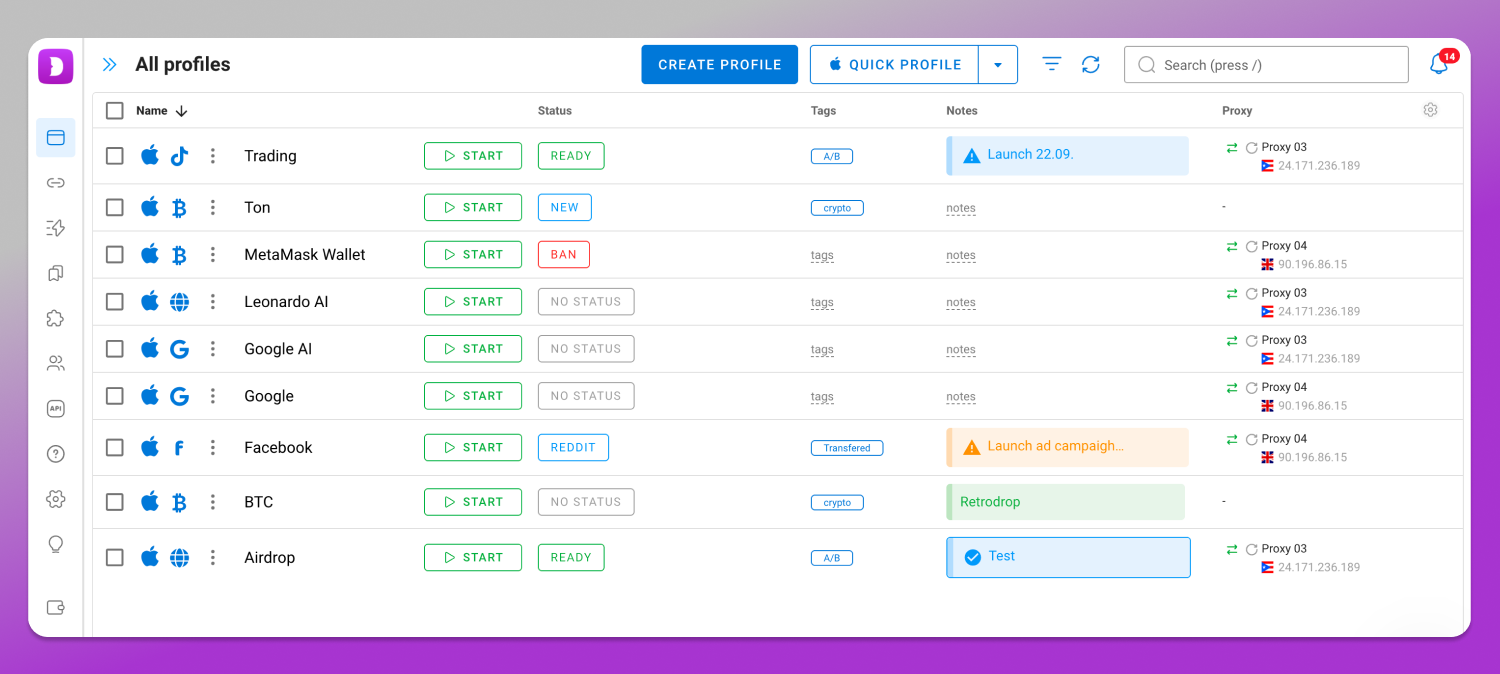
🚀 Dolphin Anty is one way to implement this. It is a desktop application for Windows, macOS and Linux, and each profile carries its own fingerprint, its own cookies and local storage, and its own proxy assignment, so profiles run side by side without sharing state. Profile limits depend on the plan, so check the current numbers on the Dolphin Anty pricing page rather than assuming. Proxies come from third-party providers listed in the partners section, and profile setup and team permissions are documented in the Dolphin Anty product documentation.
No tool guarantees an outcome. Isolation lowers the probability that a platform associates two accounts. It does not override a policy you broke, and it does not repair behavioral patterns that link them anyway.
What Not to Do
Some tactics sit in search results next to this topic. They are excluded deliberately, for a practical reason rather than a moral one: each breaks the job you came here to do.
Ban evasion. A replacement for a sanctioned account is the one behavior nearly every policy in the table names explicitly, and it converts a single restriction into a permanent one covering your device, payment method and identity.
Buying or reselling accounts. A purchased account carries the seller’s history, fingerprints and recovery details, none of which you control.
Artificial engagement between your own accounts. Self-voting, mutual follows and manufactured reviews are the pattern detection systems were built for, and they link the accounts while they do it.
Registering with someone else’s identity documents, and bypassing verification. Both create legal exposure beyond a suspended login, and both fail when a payout or an appeal requires you to prove who you are.
Bulk registration. Volume is itself the signal, and it burns the resources you need for the legitimate accounts.
The platform’s own rules take precedence over any general guidance, including this page. Reading the current policy for your platform and complying with it is your responsibility as the account holder.
Where to Start: A Short Checklist
- Open the governing document for your platform from the table and read the clause that applies to your situation. Policies change, and the document is the only authority.
- Assign one browser profile per account, and keep the pairing permanent. Never reuse a profile for a second account.
- Give each account a dedicated IP address, with geolocation, time zone and language consistent inside the profile.
- Give each account its own email address, recovery phone number and payment method. Shared recovery details are the link people forget.
- Keep shipping and return addresses separate where the platform is commercial, and avoid duplicating listings, creatives or photos across accounts.
- In a team, use per-user roles and the platform’s own delegated access instead of sharing one login, and log who has access to what.
- Warm up new accounts on a normal schedule before putting volume through them.
When the structure is settled, install the desktop application on the machine you actually work from. 📌 Dolphin Anty has builds for Windows, macOS and Linux, available from the downloads section of the site.
Frequently Asked Questions
Why do platforms ban accounts when I have not broken any rule?
Enforcement applies to clusters, not to individuals. If one account in a group is sanctioned and the group shares a fingerprint, an IP or a payment method, the action propagates. You did not break a rule. The account you were linked to did.
Is a dedicated IP per account enough on its own?
No. A unique address with an identical browser fingerprint and shared cookies still reads as one operator. Network, fingerprint and storage have to be separated together, which is why the isolation rule names all three.
What should I do if one account gets restricted?
Use the platform’s own appeal process from that account, and stop touching the related accounts from the same profile or address while the appeal is open. A replacement account is ban evasion, and it escalates the enforcement.
Does an antidetect browser make running multiple accounts legal?
It changes nothing about the legal or contractual position. It is an isolation tool. Whether you may hold a second account is decided by the platform’s terms and by the law in your jurisdiction, including GDPR, UK GDPR or CCPA/CPRA where personal data is involved.
Do I need separate profiles if the platform officially supports account switching?
For Google, Outlook or Instagram, the built-in switcher is fine when the accounts belong to you and are meant to be associated. Use separate profiles when the accounts are supposed to be independent, for example client accounts held by an agency.