
Learning how to sell on TikTok Shop starts with a piece of paperwork: the ID the platform accepts at registration. TikTok has become a real sales channel with rules of its own — you can list products, build a storefront inside the app and close the sale without the customer ever leaving the platform. This 📔guide covers the whole path: the paperwork registration requires, commissions, shipping and the strategies that bring the first sales.
The short answer: in Brazil the store only opens with a CNPJ (MEI status is enough), registration happens in the Seller Center and the commission is calculated from the product price.
What TikTok Shop is and how it works
TikTok Shop is the e-commerce layer built into the app: the seller lists products, builds a storefront and sells through videos, livestreams (live shopping) or a fixed catalog on the profile, with payment handled inside the app itself.
The difference from an ordinary marketplace is where the traffic comes from: there the buyer searched for the product; here 📹 the video shows up before any purchase intent exists. That is why a product demonstration beats a technical description.
The two roles: seller and affiliate creator
The seller lists and sells their own products, handling inventory, shipping and support. The affiliate creator promotes third-party products for a commission, with no inventory or store. Both roles can be combined, a common route for small brands that want to test the format before investing in stock.
Requirements to sell on TikTok Shop Brazil
Paperwork is where most beginners get stuck. ❗ Regulated categories require documentation beyond the CNPJ: products that need health-authority approval (supplements, cosmetics, health items) require registration or notification with Anvisa, Brazil’s health regulator; technical and electronic products require Inmetro certification; and items tied to food and agrochemicals go through MAPA, the agriculture ministry. Proof is submitted inside the Seller Center itself, under My Account > Account Settings > Qualification Center > Add Category Authorization, where the platform requests the category-specific certificates before enabling sales of those items. The seller’s own terms of service place this responsibility explicitly on the seller, not the platform.
You also need to link a bank account under the same CNPJ to receive payouts. The standard settlement window is 7 calendar days after delivery is confirmed — funds land in the Seller Center wallet on day 8, with fees already deducted. That window can extend to as much as 31 days for new accounts or ones showing risk signals, while TikTok runs security checks, and it can shorten to 3 days (“Express Payment”) for sellers with a strong performance history who meet the eligibility requirements. Settlement-tier changes are reassessed monthly, always on the 1st.
Why a CPF won’t open a store on TikTok Shop Brazil
TikTok Shop Brazil 🙅 does not accept a CPF, the individual taxpayer ID: seller registration requires a CNPJ, at minimum under MEI micro-entrepreneur status. There is no early stage in which an individual sells first and formalizes later — the requirement appears when you create the Seller Center account. Borrowing someone else’s business ID is an unnecessary risk, since the document holder answers for the operation and the payouts. Opening a MEI is free and can be completed the same day.
MEI: revenue ceiling, employees and when to move up
MEI status carries a ceiling of R$81,000 per year today, with the ceiling set to rise to R$110,000 in 2027 and R$140,000 in 2028, and it allows up to two employees. Crossing the ceiling forces a move to a small-business regime with different taxes and accounting duties. Plan the exit before you need it: if half-year projections approach the limit, talk to an accountant before the campaign that will break it.
Step-by-step registration in Seller Center
- Open the TikTok Seller Center, the dashboard separate from the app, built for store management.
- Create the seller account with the CNPJ, address, category of activity and documents.
- List your products with video, the format the platform favors.
- Set up shipping and delivery windows, with coverage areas, delivery times by region and return policies.
- Link your content account, tying videos and livestreams to the storefront.
- Wait for the review, which checks documentation before enabling sales.
Fees and commissions: working out your margin
Beyond the commission there are 💲 costs that never show up under that label: subsidized shipping, co-funded coupons, returns, packaging and video production. Add all of it before setting prices.
The price-based commission from July 15, 2026
From July 15, 2026, the TikTok Shop Brazil commission varies by product price, not by category: under R$50 it is 10% + R$4 per sale; at R$50 or above, 6% + R$6. The flat portion is what catches inattentive sellers: on a R$29 item, the fixed R$4 plus the 10% eats close to a quarter of the price. Very low-priced items stop making sense on their own — bundles and kits return more.
Shipping and logistics in Brazil
Delivery cost and timing vary sharply by region, and Brazilian buyers are sensitive to both.
- Correios vs. private carriers: timelines and coverage differ, especially in the North and Northeast.
- Free shipping: it moves conversion and needs to be built into the price, not absorbed from the margin.
- Realistic delivery windows: a promise you can’t keep produces negative reviews, and negative reviews drag down the organic reach of your videos.
Selling as an affiliate, without holding inventory
Anyone who would rather skip inventory, logistics and post-sale support has the affiliate model as the most direct route: you pick products already listed, film videos or livestreams showing the item, add the link and earn a commission on each sale. The rate is set by the seller, product by product. For the seller it is reach with no fixed media cost.
Strategies for selling on TikTok Shop and common mistakes
A registered store is only the beginning. The missteps repeat: using static photos only, ignoring shipping and return policies, failing to model the price-based commission, leaving the CNPJ for later and discovering that the store won’t open with a CPF, and treating the channel as a passive catalog.
Video content, live shopping and frequency
Videos with texture, real-world use and unboxing convert better than catalog photos, and the opening decides it: showing the product working in the first seconds holds attention, and retention is the strongest signal in distribution. Live selling streams pair real-time interaction with urgency, and posting consistently keeps the store visible.
Managing multiple stores or accounts safely
Agencies, e-commerce teams and creators with more than one brand run several seller accounts at once. Keeping each account in its own isolated browser environment prevents the platform from linking distinct accounts to the same device and blocking legitimate operations.
That is the problem 💯 Dolphin Anty solves. Every profile runs with its own fingerprint, generated across more than 20 browser parameters, and with isolated proxy and cookies: the session for store A leaves no trace in the one for store B.
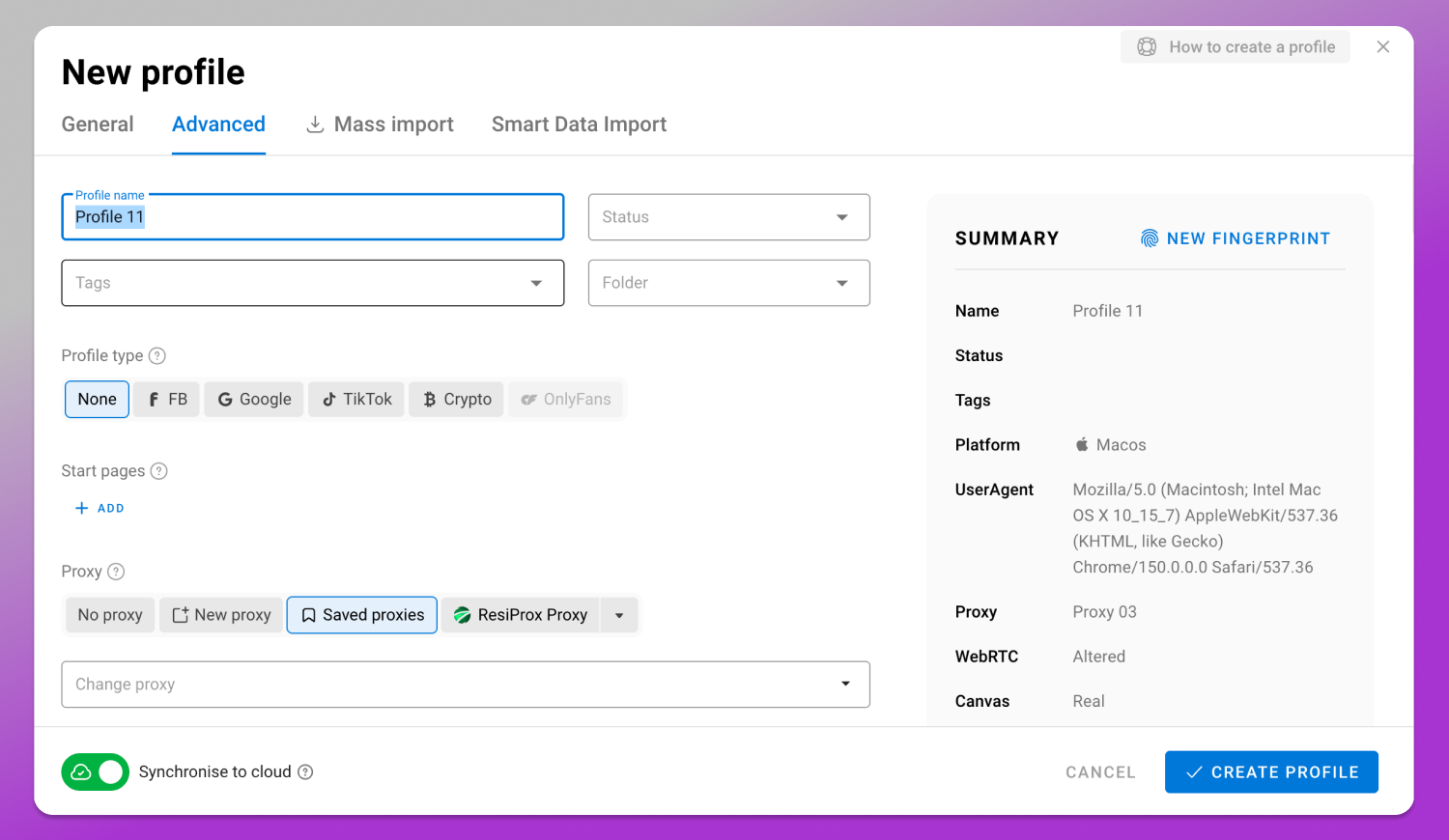
For an agency there is also team management with per-user permissions — the social media manager opens the content profile without seeing financial credentials — and API automation, which creates profiles in bulk when a new client arrives.
Tools for running multiple accounts
- Dolphin Anty — the most complete option for anyone managing several stores. Free $0 with 5 profiles, no card required; Starter $10/month (20 profiles); Base $89/month (100); Team $159/month (300); Enterprise $299/month (1,000); Custom unlimited on request. Runs on 64-bit Windows, macOS (Intel and M-series chips) and Linux (AppImage, .deb, .rpm).
- Multilogin — a well-known alternative: Free forever with 5 profiles, deleted after 7 days; Pro $11/month or $85/year (10 profiles); Business $89/month (300 profiles). It needs Windows 10+, macOS 14 Sonoma+ or Ubuntu 22+, 64-bit only; Apple Silicon M1–M4 is supported, Windows on ARM is not.
In the comparison, 🔥 Dolphin Anty delivers more profiles per price tier at the entry level and keeps free profiles with no deletion deadline.
Frequently asked questions
Can you sell on TikTok Shop Brazil with a CPF?
No. TikTok Shop Brazil does not accept a CPF for seller registration: a CNPJ is mandatory, at minimum under MEI status. The business must be formalized before you open the Seller Center account, because the document is validated at the very first stage.
How much commission does TikTok Shop charge?
From July 15, 2026 the commission depends on product price rather than category. Items under R$50 pay 10% plus R$4 per sale. Items priced at R$50 or above pay 6% plus R$6. The flat component weighs heavily on low-priced products.
What is the MEI revenue ceiling?
The limit today is R$81,000 per year, with the ceiling rising to R$110,000 in 2027 and R$140,000 in 2028. A MEI may also register up to two employees. Once the ceiling is passed, you must move to a small-business regime and adjust tax obligations.
Do I need an audience to sell on TikTok Shop?
It isn’t a prerequisite. Sellers with no followers gain traction through livestreams, through affiliate creators who promote the product for a commission and through organic video reach, which on TikTok doesn’t depend on profile size. An audience helps, but it doesn’t replace consistency.
How long does it take for the money to land in my account?
The standard is 7 calendar days after delivery confirmation, with funds released to the Seller Center wallet on day 8. New accounts or ones showing risk signals can see that window extended to as long as 31 days, and sellers with a strong performance history can qualify for 3-day settlement.
Can I manage more than one store on the same computer?
Yes, provided each account stays in an isolated environment with separate fingerprint, proxy and cookies. That is what an antidetect browser such as Dolphin Anty is for: it includes 5 free profiles at signup and keeps the platform from tying distinct stores to the same device.
Conclusion
Start with the CNPJ: in Brazil, open the MEI before anything else. Then rebuild pricing around the price-based commission, sort out shipping and delivery windows before listing, publish with video instead of photos and run one live selling session before spending on paid media. With more than one store, organize account access from the start — fixing it after a block costs considerably more.
Outside Brazil, TikTok Shop’s own local Seller Center is still live in a limited set of countries. In the Americas, only the United States, Mexico, and Brazil have an active local store as of 2026. Europe now covers nine markets (the UK, Spain, Germany, France, Italy, Ireland, the Netherlands, Poland, and Belgium), and in Asia the platform has been running longer in Indonesia, Malaysia, the Philippines, Singapore, Thailand, Vietnam, and Japan. Sellers outside those markets can only reach TikTok Shop buyers through the cross-border Global Selling program, which runs under different logistics, performance, and eligibility rules than a local store — confirm current availability directly on seller.tiktok.com before planning an operation, since the list keeps expanding.