
Ads for “ready-made” Instagram profiles promise a shortcut to anyone launching a business or a personal brand with an audience. What the listing omits is that buying Instagram accounts, or selling them, violates the terms of use.
It is not a gray area under the platform’s rules, and that changes the nature of the risk. This guide explains how the market works, what goes wrong, and what builds an audience without risking the investment.
Why a market for ready-made accounts exists
Growing organically takes months, and an account with an established audience looks like a way to skip ahead. Supply, however, comes from different sources, and that is what determines the risk.
Who sells Instagram accounts, and why
There are three kinds of seller: someone who built a niche account and lost interest; agencies that warm up profiles in bulk to resell them; and operators who create artificial accounts, pad the numbers with purchased followers, and advertise them as an organic audience — the most common case.
Where the listings circulate
Most of the supply sits in Telegram groups, on Facebook Marketplace, in local classified sites, and in social media forums, alongside account marketplaces that charge a commission on the payment. These are the same account marketplaces that broker buying Twitter accounts, now X, and that advertise themselves as the best site to sell a TikTok account. None of them has an agreement with Instagram: any guarantee applies only between the parties.
What Instagram’s terms of use actually say
Instagram is direct about this: ❗ accounts are personal and non-transferable. Anyone creating a profile accepts terms that prohibit selling, buying, or transferring ownership. In practice there is only an informal handover of credentials and the linked email address.
The platform recognizes as owner whoever clears verification. If the seller keeps access to any recovery channel, ownership effectively stays with them.
You have no legal recourse if the deal goes wrong
Consumer protection law covers lawful transactions. Because buying and selling accounts runs against the terms, the deal is irregular from the start.
If the seller recovers the account after payment, there is no invoice, no valid contract, and no vendor to pursue. Filing a police report is possible, but recovering the money is far harder.
Main risks of buying Instagram accounts
These risks rarely show up alone.
📌 Recovery by the original owner. The seller can request account recovery after payment, claiming unauthorized access: if they still hold the original email address or phone number, they usually get the profile back.
📌 Payment scams. Sellers vanishing after payment, incomplete credentials, a different profile than advertised, a password changed hours later, or a nonexistent “release fee.”
📌 Suspicious pattern detection. Instagram monitors abrupt changes in device, IP address, and location — exactly the signals an ownership handover produces. That brings extra verification, suspension, or a ban.
📌 Inflated followers. A large share of the profiles on offer had their numbers padded by bots: real reach ends up far below the total.
📌 Inherited history. A purchased account carries previous reports, removed content, and possible participation in artificial engagement schemes, which raises the odds of future penalties.
What Instagram accounts sell for, and why the price misleads
Listings price the account by follower count, as if every thousand carried a standard rate. There is no official or regulated pricing source — figures come from informal account marketplaces (FameSwap and similar sites), and vary widely based on the claimed “quality” of the profile. Broadly, what’s publicly visible on those marketplaces shows small accounts (in the thousands-of-followers range) going for roughly $100 to a few hundred dollars, and large profiles, in the hundreds of thousands of followers, reaching $10,000 or more. Some marketplaces also charge a brokerage commission on the sale — typically 5% of the transaction value or a fixed minimum fee, whichever is higher.
Converted to a per-thousand-followers rate, individual listings on these informal channels tend to cluster around $5 to $6 per thousand — though that figure carries little real meaning, since it says nothing about audience quality, niche, or engagement, and comes from sellers with no obligation to tell the truth.
A follower, however, is not a transferable asset: revenue comes from the relationship between the audience and the person posting — editorial angle, voice, frequency — which breaks when the owner changes.
How to audit a profile before any negotiation
One caveat: 🔎 auditing does not make the purchase permitted. The transaction still violates the terms — the check only limits the loss for anyone who negotiates regardless.
The minimum check uses data the seller can share without handing over the account: screenshots of the insights panel showing reach and geographic distribution, month-by-month growth, and recent posts.
📣 Warning signs: engagement below what the account size suggests, growth spikes on isolated dates, repeated generic comments and an audience in countries unrelated to the niche. On the scale of the problem: no public study specifically audits the accounts listed for sale on these informal marketplaces, but broader influencer-fraud research on Instagram suggests a meaningful share of many accounts’ audiences — market estimates cite figures ranging from roughly a third to well over half of followers, depending on niche and account size — shows signs of being inauthentic or purchased. Those figures are worth treating with some caution: several of the most widely repeated fake-follower statistics circulating online do not trace cleanly back to a verifiable primary source, so the most reliable approach is still to audit each profile individually using the signals above, rather than lean on any single market-wide benchmark.
Safer alternatives for growing on Instagram
📌 Build the account from scratch with a content strategy. It takes longer, but it retains an interested audience with predictable conversion.
📌 Invest in official paid ads. Meta’s advertising tools target audiences by interest, behavior, and location, without violating the terms.
📌 Partner with creators. Collaborations with people who already speak to your niche deliver a qualified audience.
📌 Reposition an account you already own. Redirecting a personal profile or a previous project is legitimate and carries no risk.
📌 Hire an organic growth consultant. The fee covers delivered work, and the result stays with you.
How to manage multiple legitimate accounts safely
A different and fully legitimate scenario: agencies, creators, and businesses running several accounts of their own or for clients, all with documented ownership. The challenge is preventing the platform from tying distinct profiles together and treating the operation as a coordinated network.
That is the problem 🚀 Dolphin Anty solves: each profile runs with its own fingerprint, configurable across more than 20 parameters, and with isolated proxy and cookies — the platform sees independent environments, not dozens of logins from one machine. For teams there is per-user permission management and automation through an API, which removes the need to share passwords, and signing up unlocks 5 free profiles, no card required.
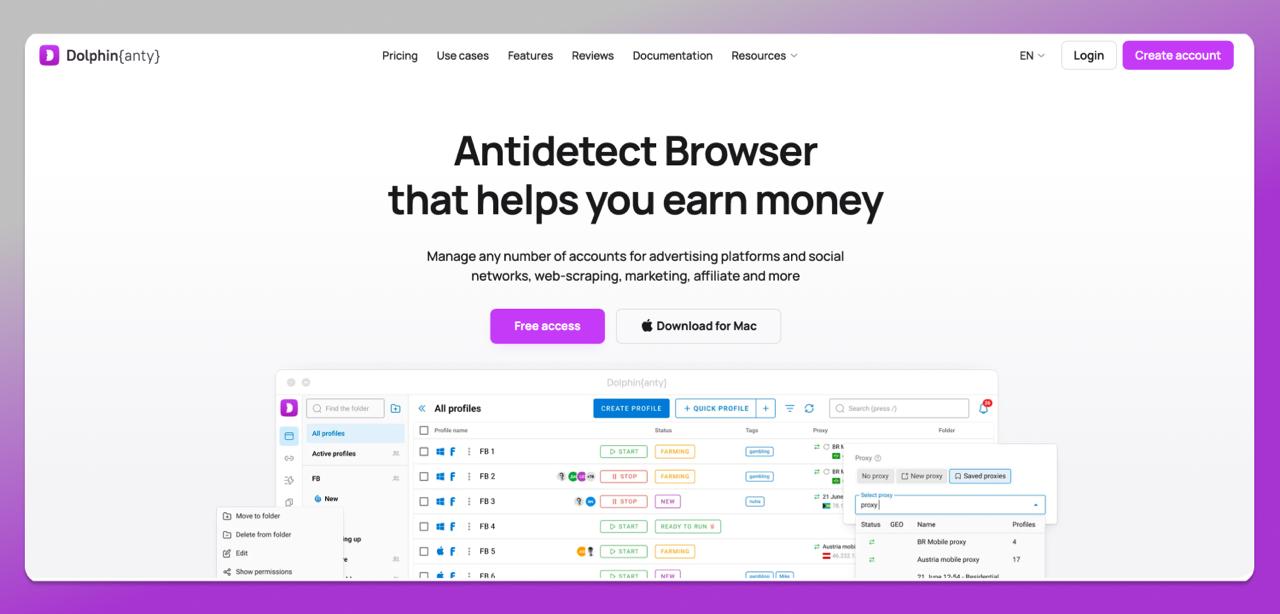
The limit is clear: an antidetect tool organizes legitimate profiles, but it does not validate ownership of a purchased account or override the ban in the terms. Masking the environment does not turn a purchased profile into your own.
Tools for managing multiple profiles
Dolphin Anty — the best option for anyone managing many accounts. Free at $0 with 5 profiles, Starter $10/month with 20, Base $89/month with 100, Team $159/month with 300, and Enterprise $299/month with 1000 profiles, plus Custom, with unlimited profiles and pricing on request. It runs on 64-bit Windows, macOS (Intel and M-series chips), and Linux (AppImage, .deb, .rpm).
Multilogin — Free forever with 5 profiles that are deleted after 7 days, Pro at $11/month (10 profiles) or $85/year, and Business at $89/month (300 profiles). It requires Windows 10+, macOS 14 Sonoma+, or Linux Ubuntu 22+, always 64-bit, with 4 GB of RAM and 1 GB of disk. It is compatible with Apple Silicon M1 through M4 but not with Windows on ARM.
Frequently asked questions
Is buying an Instagram account illegal?
Buying one is not usually a criminal offense in itself, but it violates the terms of use and allows the profile to be suspended at any moment. Selling an account you do not own, or delivering something other than advertised, can amount to fraud.
Can I get my money back if I am scammed?
Rarely. Without a valid contract, an invoice, or an identifiable vendor, standard consumer protections generally do not apply. Filing a police report is advisable, but getting the money back depends on identifying and locating the seller who vanished with it.
How can I tell if a profile has fake followers?
Ask for insights panel screenshots and compare the follower count against average likes, comments, and reach per post. Growth concentrated into a handful of days, repeated comments, and an audience in countries outside the niche point to an artificial base.
Does Instagram notify you when it detects an ownership change?
Not always, and the warning is rarely explicit. The platform usually requires extra verification, asks for confirmation by the registered email or phone number, or restricts access without explaining why. In some cases the account simply stops opening on the new device.
Is an aged account better than starting fresh?
Usually not. Age matters less than the coherence of the history. An old account from a different niche delivers a misaligned audience, and the algorithm keeps serving content to that earlier public. A well-built new profile usually performs better — and creating one is allowed, buying one is not.
Conclusion
Buying an Instagram account is a transaction the platform does not recognize: the seller can recover the account, Instagram can suspend it, and the followers may not be a real audience.
For anyone managing several legitimate accounts, the way forward is to isolate environments and control access with 🔥 Dolphin Anty, under documented ownership.
Read next: How to download Instagram photos safely