
Hiring a paid traffic agency means handing a chunk of your marketing budget to someone outside your company and trusting them to spend it well. Get it right, and the return shows up fast. Get it wrong, and the money disappears into clicks that never turn into sales, and you usually don’t notice until months later, staring at a report full of numbers that look great and mean nothing.
📣 The short answer: check the business registration and the written contract, insist on admin access to the ad account, ask for a report that leads with revenue, and start with a short trial. This guide covers each criterion in detail.
What a paid traffic agency actually does
Stripped down, paid traffic management is planning, building, and optimizing campaigns on platforms like Google Ads, Meta Ads, and increasingly TikTok Ads, with the goal of driving qualified visitors to your site, your store, or your landing page.
Ongoing optimization is the product you’re paying for
A serious agency doesn’t sell clicks: it sells a process of testing, learning, and adjusting. A campaign that looks identical on day one and day thirty usually means nobody is really managing it — no creative testing, no audience refinement, no bid adjustments based on the data.
What usually falls outside the scope
Creative production, sales page copy, technical fixes on the site, and CRM integration aren’t always in the contract. Ask in writing for what’s covered and what gets billed separately, before you start comparing prices.
Check the basics before any meeting
Before evaluating a proposal, portfolio, or sales pitch, 👉 confirm the fundamentals:
- Registered business entity with tax registration matching the service being sold.
- Written contract covering scope, term, rate adjustments, and exit terms.
- Proper invoicing for services, which also keeps your own accounting clean.
- Ownership of the ad accounts and the assets created during the engagement, in a specific clause.
Red flags
Some behaviors show up before the proposal even lands, and they say a lot about what the working relationship will feel like.
Promises, pricing, and contract length
📌 Guaranteed specific outcomes. “We guarantee 100 leads a month” is a warning sign: nobody controls market conditions, competition, and buyer behavior tightly enough to promise that honestly.
📌 Pricing far below the market. A cheap agency that wastes half your media budget ends up costing more than one that charges double and optimizes every dollar spent.
📌 Long contracts with no trial period. Nobody should lock you in for a year before proving they can run your account. A short test, with goals agreed in writing, is a reasonable minimum.
Access, reporting, and who runs the account
You don’t get access to your own ad account. If the agency holds the account under its own name without giving you admin access, you lose your history and your bargaining position the moment you consider switching providers.
Reports built on vanity metrics. Impressions, reach, and clicks have diagnostic value, but they shouldn’t headline the document. What matters for the business is revenue, ROAS, CPA, and conversion rate.
No clarity on who’s running the account. You have a right to know who decides how your budget gets spent, even when part of the work goes to contractors.
What a good onboarding process looks like
A mature agency 👍 asks about your business before talking about campaigns: average order value, margin, support capacity, media history, and where conversions break down. That’s a sign the team is thinking about business outcomes, not just platform metrics.
The calibration phase and what comes after it
Expect heavier adjustments in the first few weeks: every new account goes through calibration, and platforms need to accumulate conversions before the data stabilizes. What’s not normal is that period never ending. After it, expect more efficient channels and more predictable conversion.
Questions worth asking before you hire
Ask for concrete examples from campaigns similar to yours, with real result numbers. Ask how the optimization routine works: who touches the account, how often, and how adjustment decisions get made. Ask who your point of contact will be, too, and how much authority that person actually has.
Vague answers, jargon without explanation, or refusal to share real examples are all signs to keep looking.
Transparency and reporting: what to demand
A useful 📋 report leads with revenue and ROAS, compares honestly against the previous period — including the bad months — and ties every metric back to the company’s bank account. Revenue buried on page six under a pile of reach charts usually means the revenue story isn’t good enough to lead with.
Demand clarity on how the media budget gets split across platforms and campaigns, and agree on how often you get updates.
How to assess the operation of an agency with many accounts
One part of the job that rarely gets talked about is operational: running dozens of client ad accounts from the same team and the same devices, without turning it into a security problem or getting accounts blocked for looking connected to each other.
Isolation by browser profile
More mature agencies keep access to each client account inside separate, isolated environments: each browser profile with its own configuration, no shared cookies, sessions, or history. When evaluating a provider, ask how they organize that access: the answer says a lot about how mature the team is.
Tools for managing multiple accounts
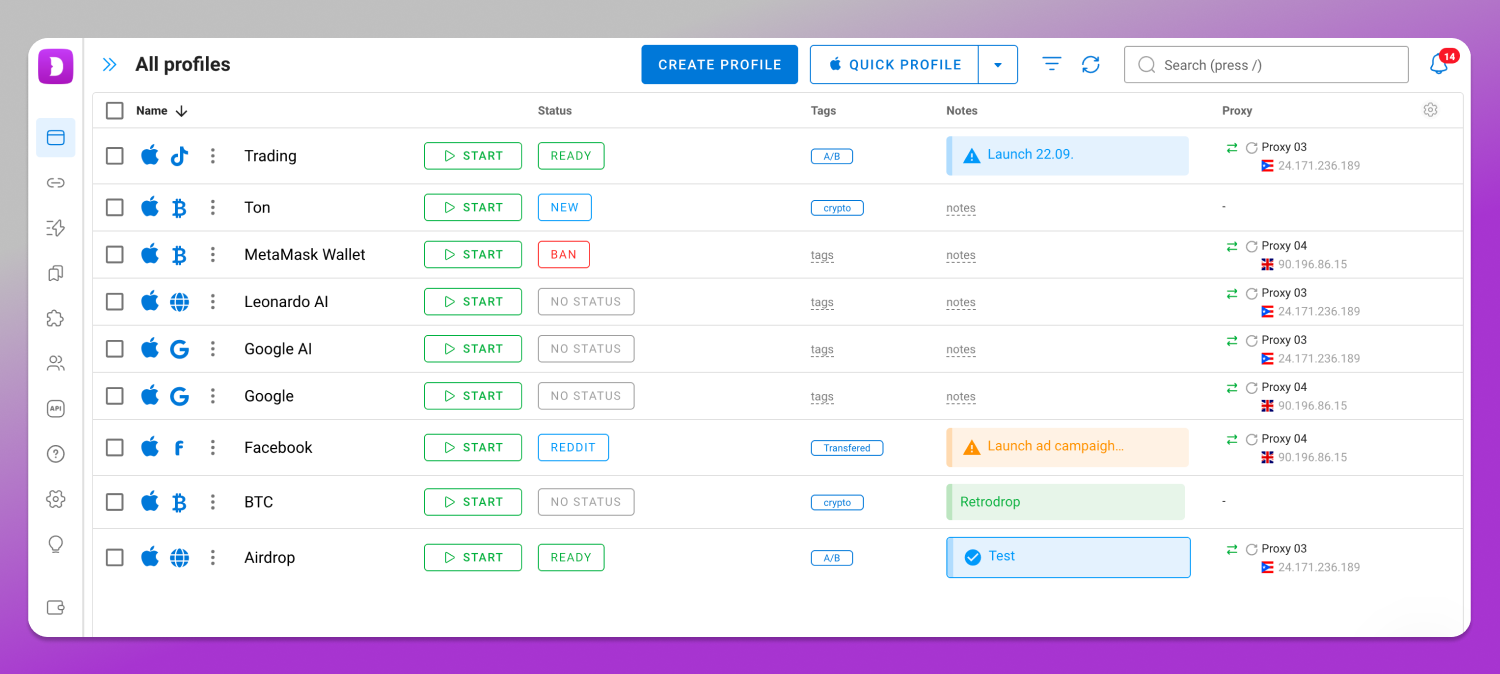
No tool replaces a process, but it keeps that process from depending on each person’s memory. That is what an antidetect browser like 🔥 Dolphin Anty handles: control over who logs into which account, with which proxy and which browser identity, and the option to revoke access when someone leaves.
- Dolphin Anty — the best option for anyone managing several accounts at once: its own fingerprint per profile across more than 20 parameters, isolated proxy and cookies per profile, team management with per-user permissions, and automation through the API. Plans: Free $0 (5 profiles), Starter $10/month (20 profiles), Base $89/month (100 profiles), Team $159/month (300 profiles), Enterprise $299/month (1,000 profiles), and Custom with unlimited profiles priced on request. It runs on Windows 64-bit, macOS (Intel and M-series chips), and Linux (AppImage, .deb, and .rpm).
- Multilogin — Free forever with 5 profiles, deleted after 7 days, Pro $11/month or $85/year, and Business $89/month. It requires Windows 10+, macOS 14 Sonoma+, or Linux Ubuntu 22+, always 64-bit, with at least 4 GB of RAM and 1 GB of disk; Apple Silicon M1–M4 is supported; Windows on ARM is not.
The practical detail is in the signup: 🚀 Dolphin Anty gives you 5 free profiles without asking for a card, so you can test the workflow before migrating the whole operation.
What it costs to hire a paid traffic agency
Pricing varies with media budget size, campaign complexity, and the billing model. Three structures show up most often in proposals.
Billing models and how to compare proposals
- Flat monthly fee — a fixed amount, independent of media spend. Across the industry (multiple US-based agency pricing guides), small to mid-sized accounts typically run $500 to $5,000/month, with the lower end fitting single-platform, lower-spend accounts and the upper end fitting multi-platform management. Enterprise-level retainers commonly reach $10,000 to $25,000+/month for complex, multi-channel accounts.
- Percentage of ad spend — the agency charges a share of what you spend on ads. The industry-standard range is 10% to 20% of monthly ad spend, with some agencies charging closer to 25-30% on smaller budgets (to cover a practical minimum) and dropping to roughly 5-12% on large budgets, where a flat percentage would otherwise produce an outsized fee.
- Hybrid — a minimum fee plus a percentage above a certain spend threshold.
Request proposals from at least three agencies and compare what each one includes: number of campaigns, creative production, reporting frequency, and support hours.
A quick gut check before you sign
If you can’t get a straight answer to these three questions, that’s usually enough information on its own:
- Who exactly will manage my account day to day?
- What happens to my ad account and its history if we part ways?
- What does a bad month look like in your reporting?
A trustworthy agency answers all three without hesitating, because none of the three threatens a partnership built on actually delivering results.
Frequently asked questions
Is it worth hiring an agency or a freelance media buyer?
It depends on the size of your operation. A freelancer tends to be cheaper and more agile for smaller businesses. An agency with a multidisciplinary team pays off once the media budget grows and several platforms start running at the same time, demanding more hands.
How do I know if an agency is trustworthy?
Check the business registration and the contract, ask for case studies with real metrics, and test a short engagement before committing to a long contract. Insist on admin access to your own ad account, and notice whether the answers are specific or merely generic.
How long does it take to see results from paid traffic?
There’s no fixed timeline: it depends on the platform, the account history, and the volume of conversions accumulated. Before enough data exists, any performance reading is provisional. Agree with the agency on which milestone gets evaluated and on what date.
Should I be suspicious of an agency that promises fast results?
Yes. Marketing isn’t instant magic, and a promise of speed often hides a rush to close the contract. Be wary of any proposal that skips over the natural testing, error, and learning period that every campaign needs before spending can scale up safely.
Is a lower price always worse?
Not necessarily, but it deserves extra scrutiny. A cheap agency that manages the media budget poorly, with no optimization and no creative testing, can end up costing more. Compare the total cost of the operation over the life of the contract, not just the monthly fee charged.
How much does a paid traffic agency typically charge?
On the flat-fee model, small to mid-sized accounts typically pay $500 to $5,000/month, with enterprise retainers running $10,000 to $25,000+/month. On the percentage model, the standard range is 10% to 20% of monthly ad spend.
Conclusion: what to take from this evaluation
Choosing an agency has less to do with finding the cheapest one and more with finding the one that explains its own work without hedging. Paperwork in order, a clear contract, admin access in your hands, and a report that leads with revenue already remove most of the risk.