
Agencies that make money niche down. You stop being a social media agency and start being the agency for high ticket fitness coaches, or med spas, or window installers. Then you sell the same offer fifteen times, because you already know it works.
⚠️ That is the whole business model, and it creates a problem nobody warns you about.
Your fifteen clients are near-identical businesses. Same offer, same price point, same objections, same audience. The funnel that works for one works for all of them, so you reuse it. The DM script that books calls for one books calls for all of them, so you reuse that too.
And that is the moment fifteen separate businesses start looking, to Instagram, like 👀 one operation running fifteen accounts.
The skill in running a portfolio is knowing exactly which parts of your system to reuse and which parts must never repeat. Get that line wrong in one direction and you rebuild everything from scratch for every client, which does not scale. Get it wrong in the other direction and you lose accounts in batches.
The line: share the system, never the surface
Here is the distinction that makes the whole thing work.
🔥 The system is yours. The funnel architecture, the qualification logic, the stage definitions, the follow up cadence, the SOPs your team runs, the reporting format you show on calls. None of this is visible to Instagram. All of it should be reused across every client in the niche, because that reuse is precisely what makes a niched agency profitable.
👨💻 The surface belongs to each client. The account, the browser profile, the proxy, the recovery details, the actual words in the actual messages, the leads, the conversations. None of this should ever be shared, and the last three are where agencies get caught.
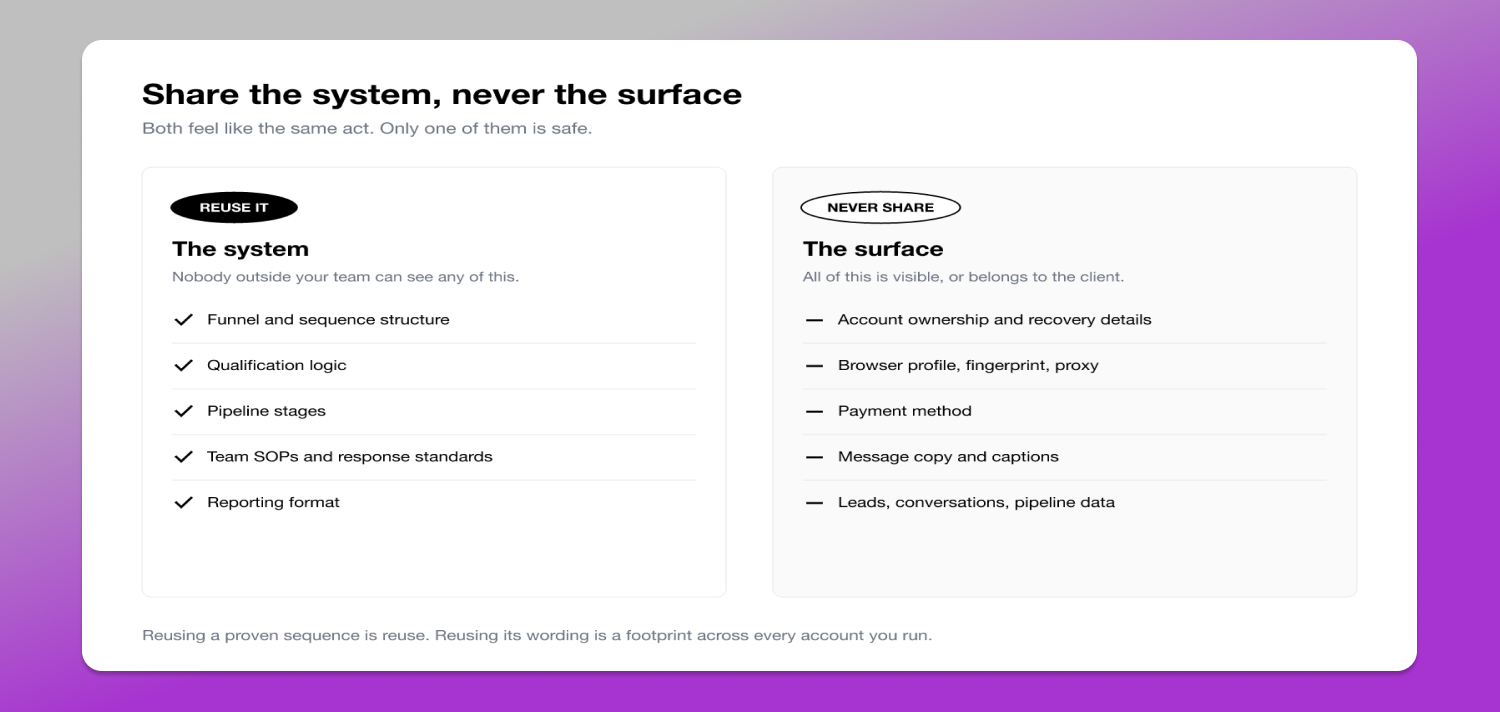
The trap is that both feel like the same act. Reusing a proven DM sequence feels like reusing a proven funnel. It is not. One is a structure nobody outside your team can see. The other is text that fifteen accounts send to strangers, and identical text across accounts is one of the most reliable spam signals there is.
The content footprint, which is the one that actually catches people
Work through it concretely.
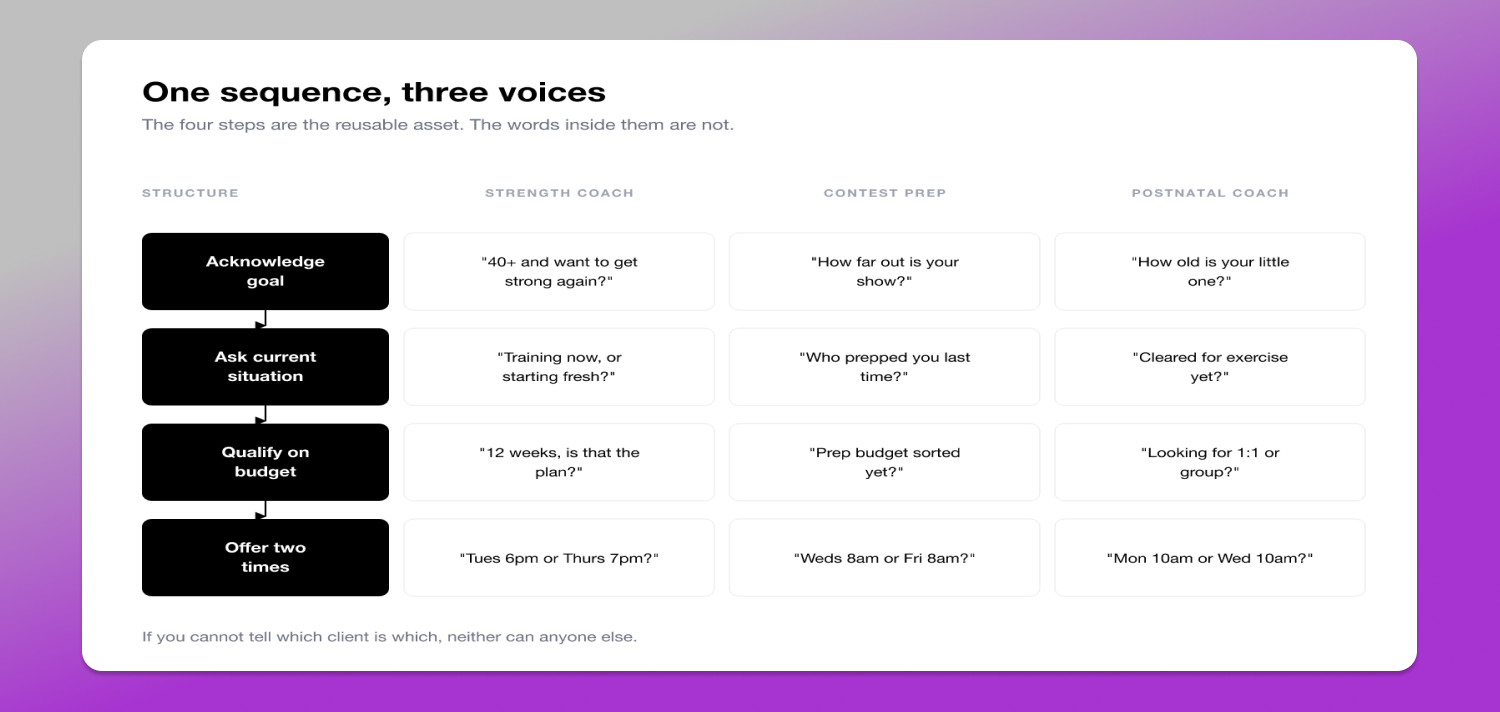
You have a DM sequence that books discovery calls for fitness coaches. It opens by acknowledging the lead’s goal, asks about their current training, qualifies on budget, offers two call times. It converts. Naturally you want it running for all fifteen clients.
If you deploy that as fifteen copies of the same text, you have created a content level link between fifteen accounts that survives perfect isolation on every other layer. Different device, different proxy, different everything, and it does not matter, because the message bodies match. Spam classifiers are built to find exactly this, and one recipient reporting it damages all fifteen rather than one.
Template the structure, not the strings.
♻️ The reusable asset is: acknowledge goal, ask current situation, qualify on budget, offer two times. Four steps and the logic connecting them. That is your intellectual property and it is invisible.
What sits inside each step should be written per client, in that client’s voice, referencing that client’s actual offer. A coach selling a twelve week strength programme to men over forty does not sound like a coach selling contest prep to competitors, and if your messages make them sound identical you have a worse funnel as well as a riskier one.
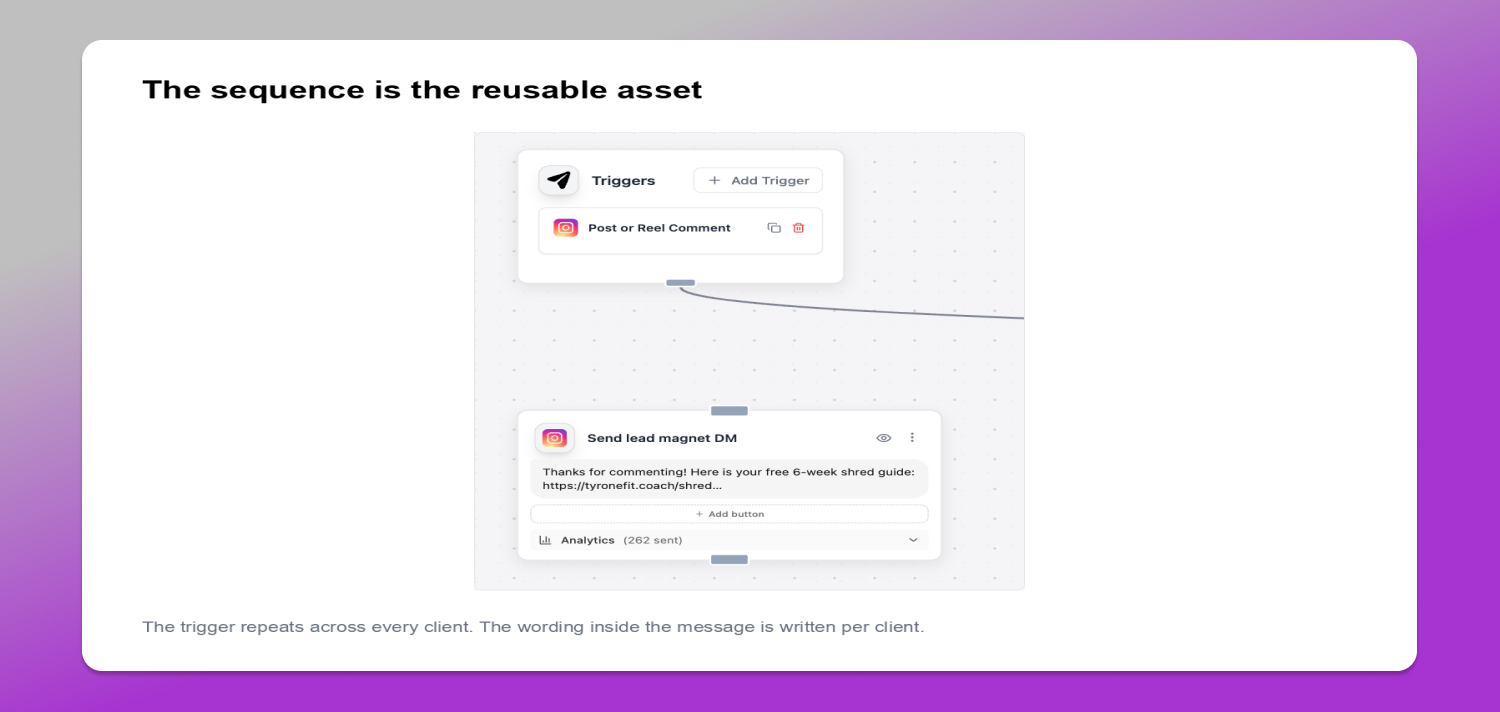
Practically, that means your tooling should hold sequences as steps with per client copy rather than as one block of text applied everywhere. Any CRM for marketing agencies worth using will let you build a sequence once and then vary the wording per client rather than forcing you to choose between copying everything and building everything.
🔎 A quick test. Take the same step from three different clients and read the three messages side by side. If you cannot tell which client is which, neither can anyone else, and that includes the systems looking for coordinated accounts.
Separation is a client promise before it is a safety measure
The isolation part of this gets discussed as a platform risk question. It is also, more immediately, a commercial one.
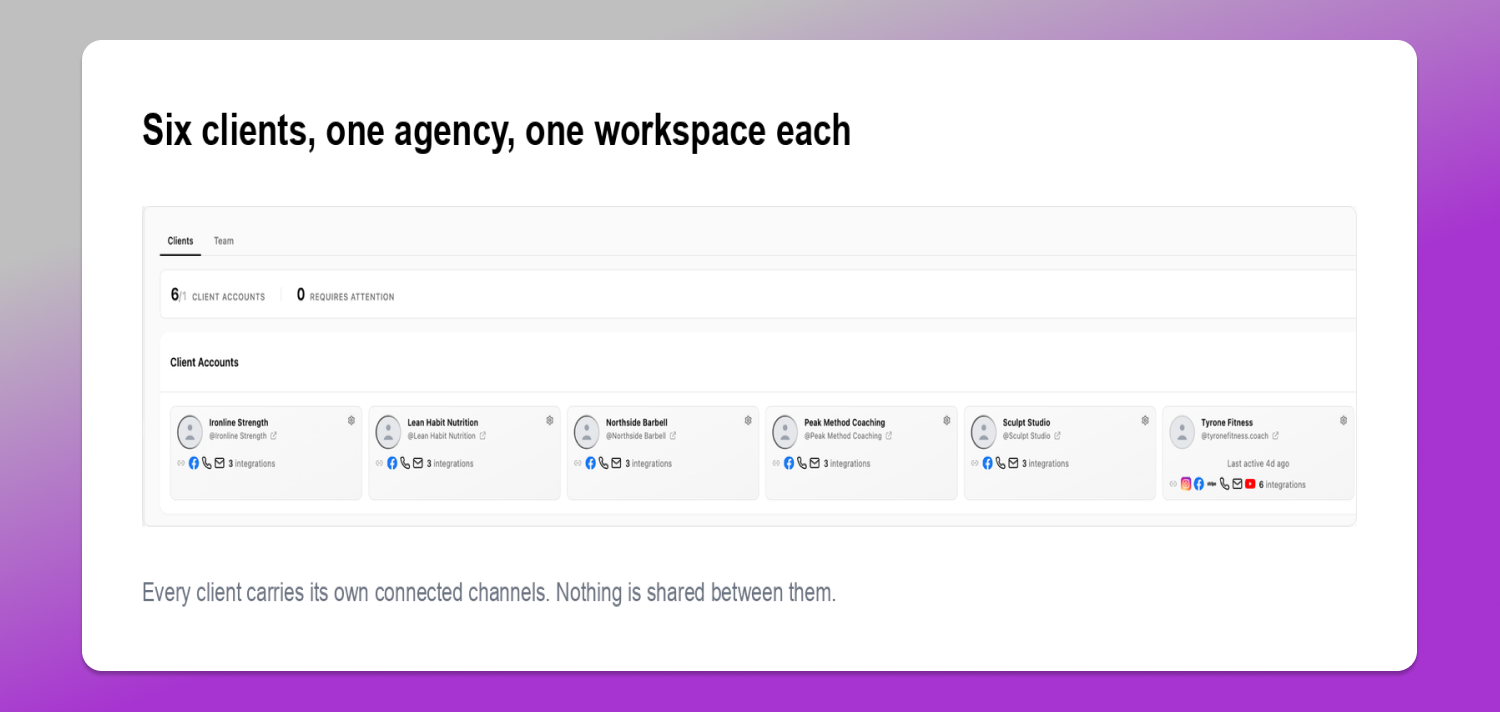
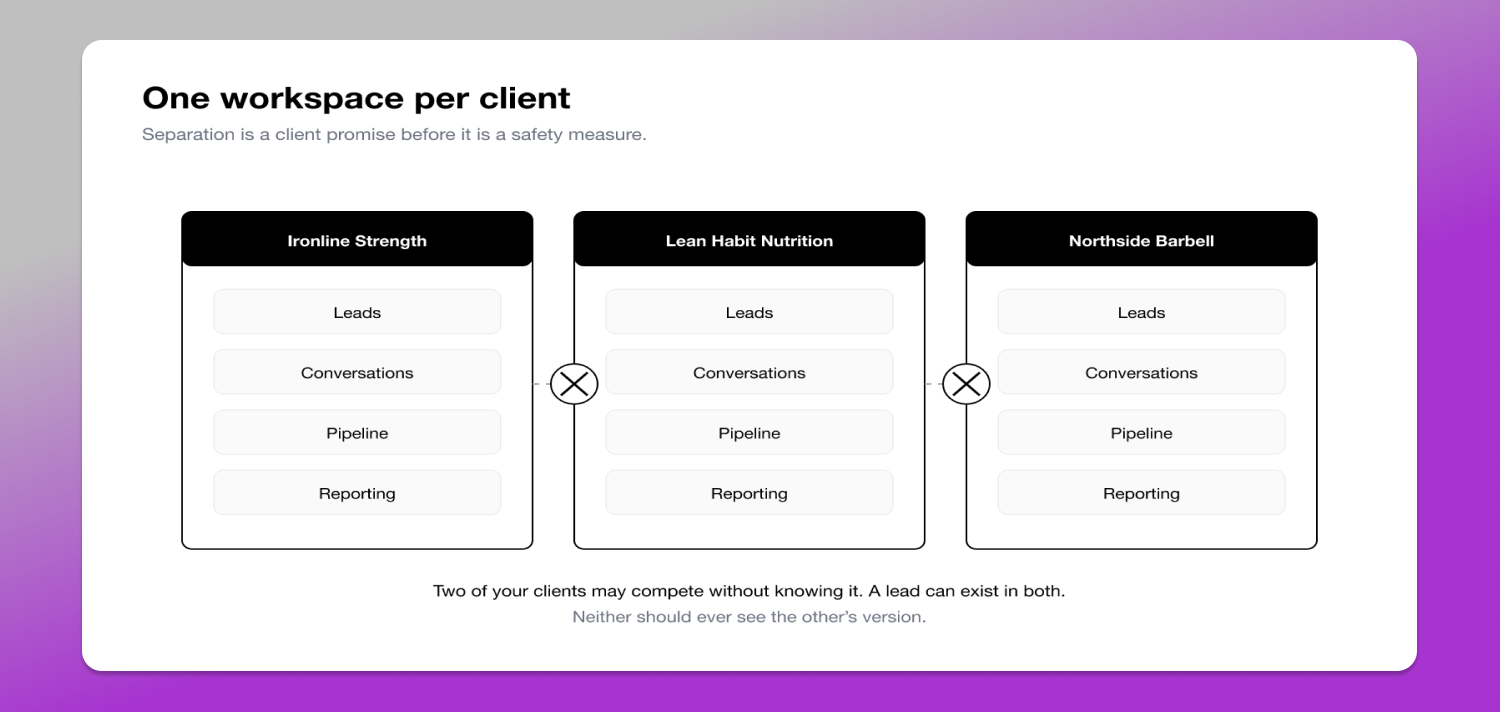
Two of your fitness clients compete. They may not know it, but they sell similar programmes to similar people, and sometimes to the same people. If a lead messages both, that lead exists twice, in two separate businesses, and neither client should ever learn about the other’s version.
🔒 This is why per client separation is not paranoia. It is the thing you are being paid for.
👯 Identity separation. Each client gets a persistent browser profile with its own stable fingerprint, cookies, local storage and proxy. This is what 🚀 Dolphin Anty is for, and in a portfolio agency it matters more than usual, because your clients genuinely are more similar to each other than a random set of accounts would be. Similar audiences, similar posting patterns, similar content calendars. The behavioural signals already overlap, so the device and network signals must not.
The mistakes are ordinary ones. Opening a client account from your normal browser to check something, once. A team member logging into a client account on their own laptop. Running eleven client accounts through four proxies. Rotating a proxy mid session when a real person’s IP does not change every ninety seconds.
Keep each profile internally consistent too. A US proxy paired with a Warsaw timezone says more than no proxy at all.
Data separation. The leads, conversations and pipeline for each client have to be scoped so that your team sees only what they are working on and no client’s data can surface inside another’s reporting. If your setup is one big shared inbox with a tag per client, you are one filter mistake away from an awkward conversation.
Answering fifteen inboxes, which is where the day actually goes
Everything above is setup. This is the part that consumes the week.
Fifteen clients is fifteen inboxes, fifteen comment streams, and fifteen places a message can sit unanswered. Instagram’s Messaging API lets a business reply within 24 hours of the lead’s last message, and after that the thread closes to standard replies. For a high ticket coach, a missed window is not a missed message, it is a missed four figure sale, and they will notice.
Logging into fifteen profiles several times a day does not survive a real workload. So agencies reach for the thing that undoes all of it: a bot replying automatically, at machine pace, with the same text, from every account. Uniform intervals, identical content, no rest. That is the pattern, and you have now hit the footprint problem and the behavioural problem at the same time.
🧩 The structure that works keeps the two layers apart.
The antidetect browser owns identity: each client’s session, isolated and consistent, never touched by a script.
A separate inbox layer owns conversations: connected through the official Instagram Messaging API rather than by driving the web interface, so your team sees and answers everything from one place without opening a single one of those sessions.
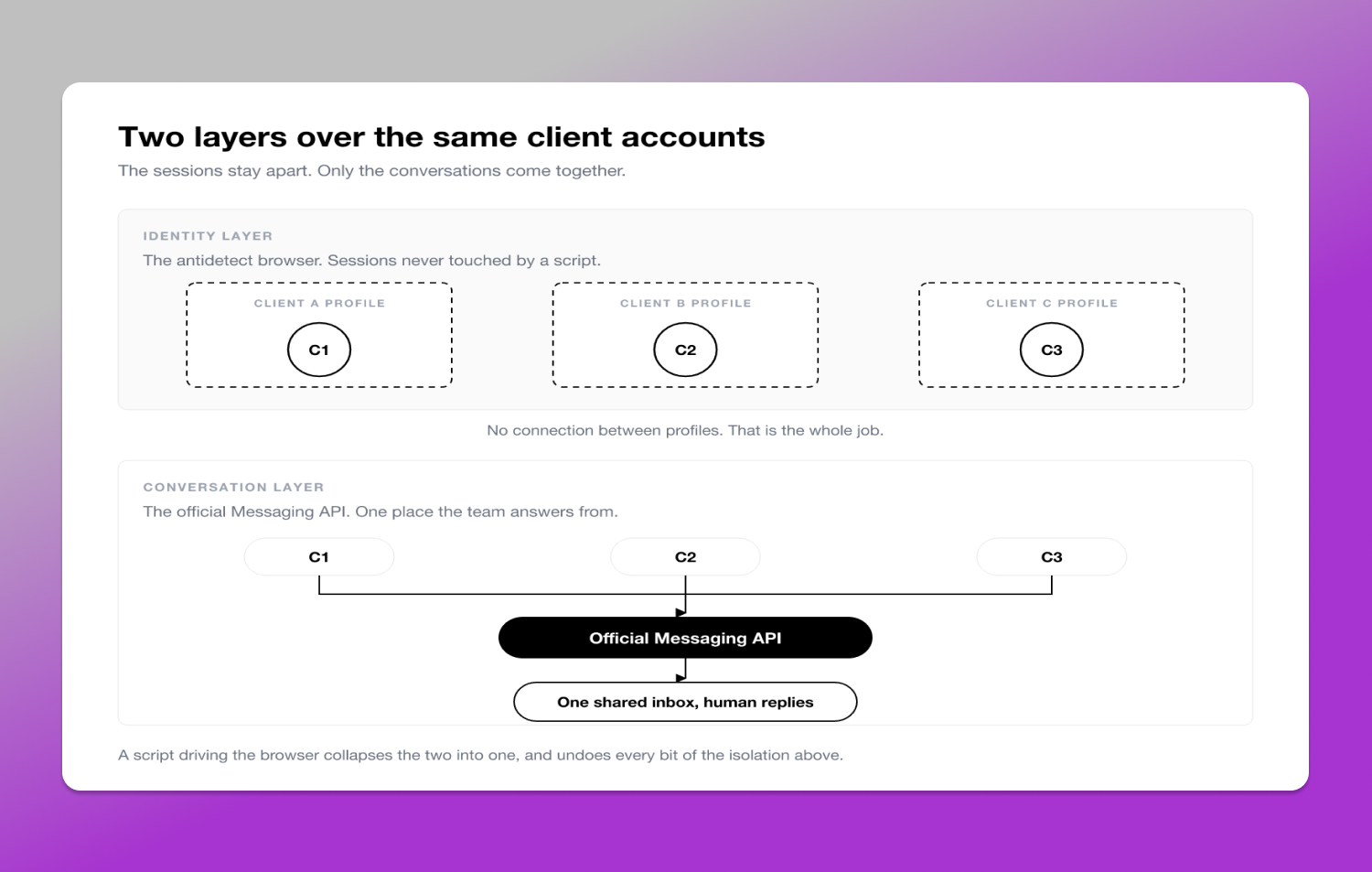
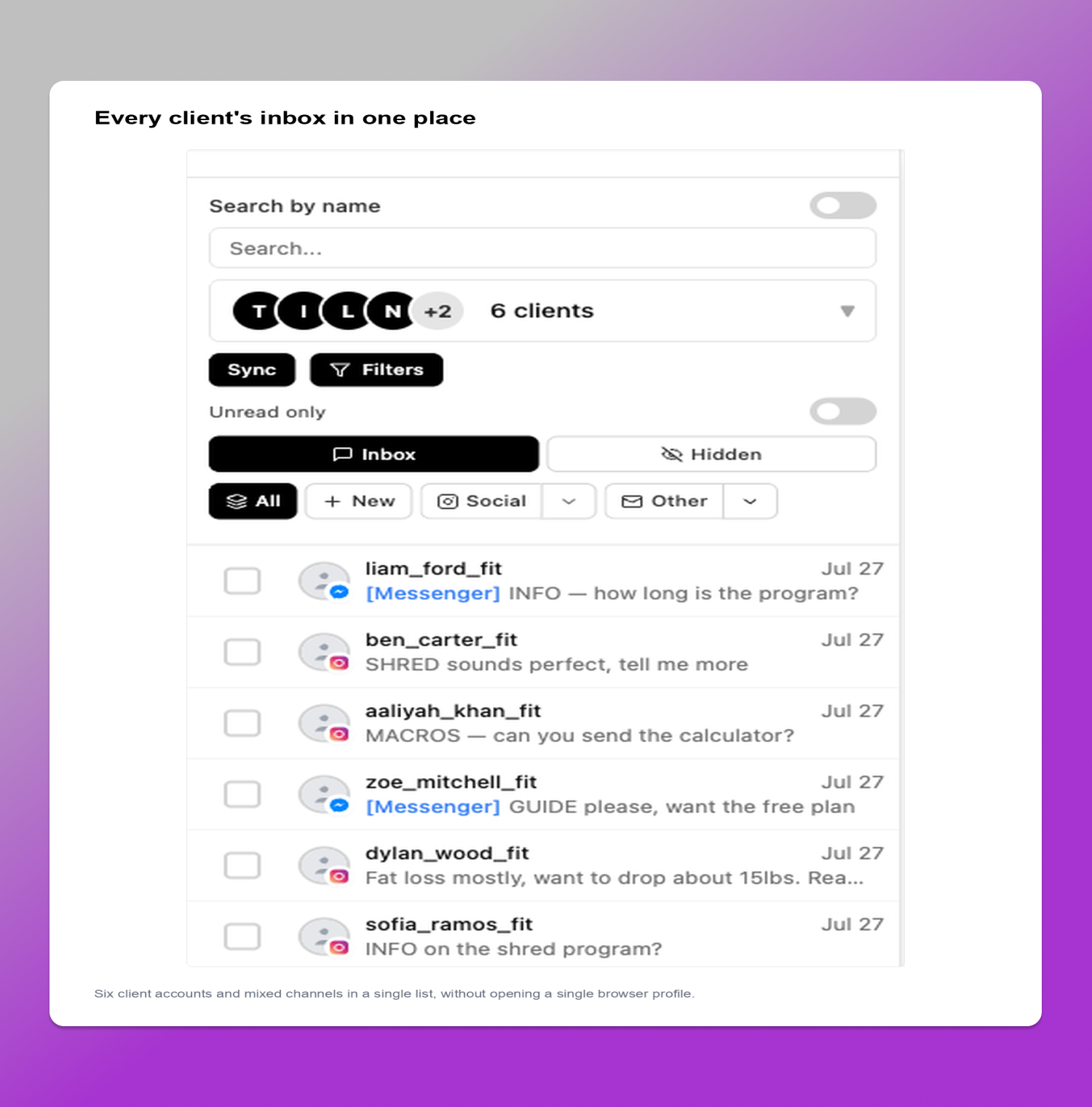
The two approaches look identical from outside and are opposites underneath. A script driving the web UI is indistinguishable from a bot because it is one. The official API is a declared, permitted integration the platform provisions itself, and a human reply sent through it carries human timing because a human sent it.
We built 🌊 Inflowave for this layer: every connected account’s DMs, comments and story replies arriving in one shared inbox, each client scoped to its own workspace, with sequences you build once and word per client.
The principle holds whatever you use: automate the plumbing, never the person. Routing, assignment, notifications and record keeping are all safe to automate, because none of them are actions the platform sees. The words in the message should be written by a human.
Ownership, and the day a client leaves
One structural decision underpins all of it, and portfolio agencies get it wrong more often than most because they onboard quickly.
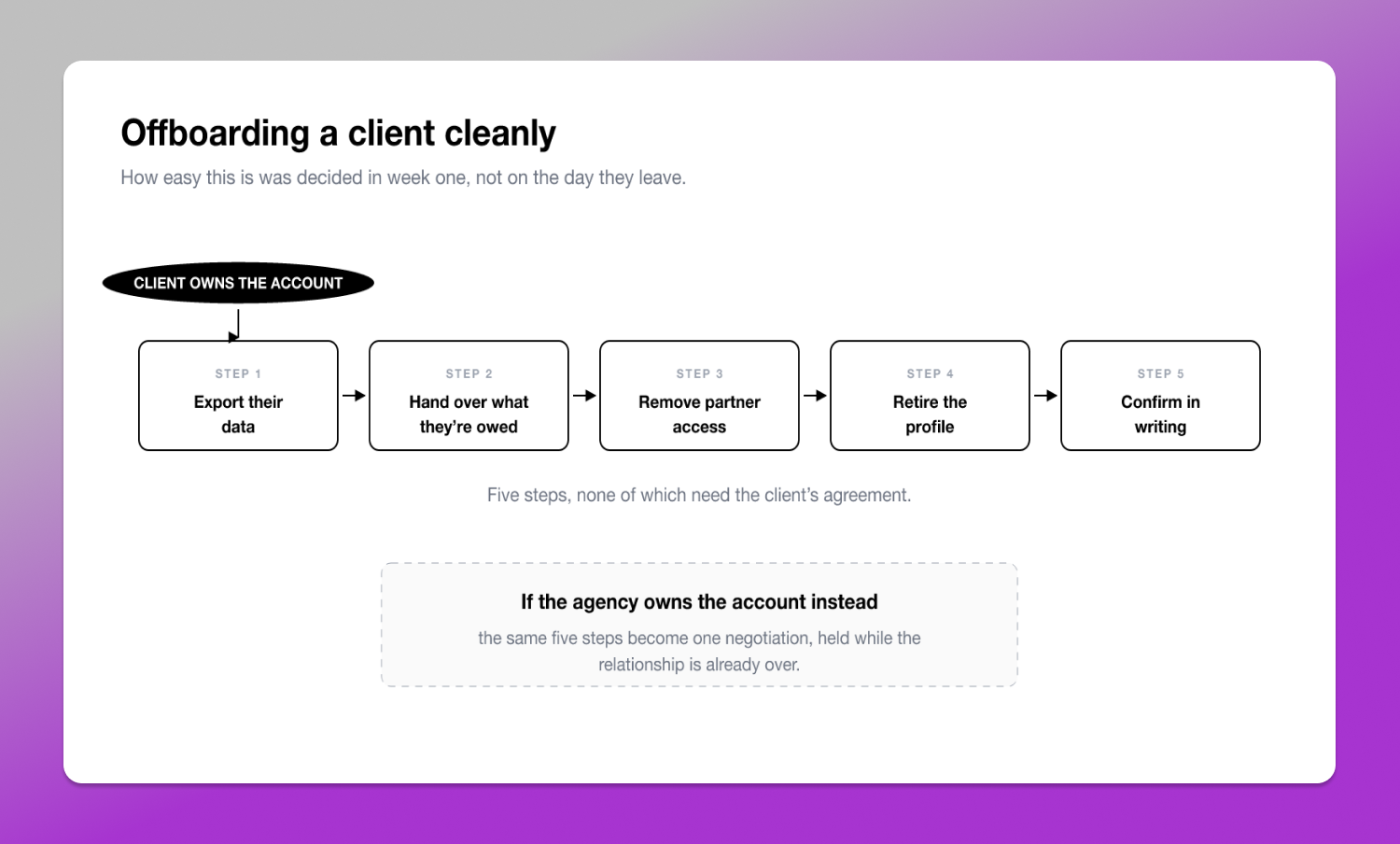
The client should own the account. You take access, through their Business Manager, granted to yours.
When you hold fifteen clients’ accounts yourself, all fifteen share your recovery email, your phone number and your card. That links them permanently, including after any are deleted. It also means one billing dispute reaches the whole portfolio, and every offboarding becomes a negotiation over who keeps the followers.
When the client owns the account, offboarding is a permission change. Export their data, hand over what they are owed, remove your partner access, retire the browser profile, confirm in writing. Nothing in that list requires their agreement, which is exactly what you want on the day a relationship ends badly.
For a niched agency this matters more than average, because your clients talk to each other. They are in the same masterminds and the same group chats. A clean exit is marketing.
Reporting, briefly
The reporting format is one of the things you should absolutely reuse. Every client in the niche cares about the same numbers, so build the view once.
What Instagram reports natively will not do it. Reach and impressions do not answer the only question a high ticket coach actually has, which is how many conversations turned into calls and how many calls turned into clients. Most agency management software exists to close that gap between activity and outcome.
Reporting on impressions when the client is paying for booked calls is how good work loses a renewal.
The checklist
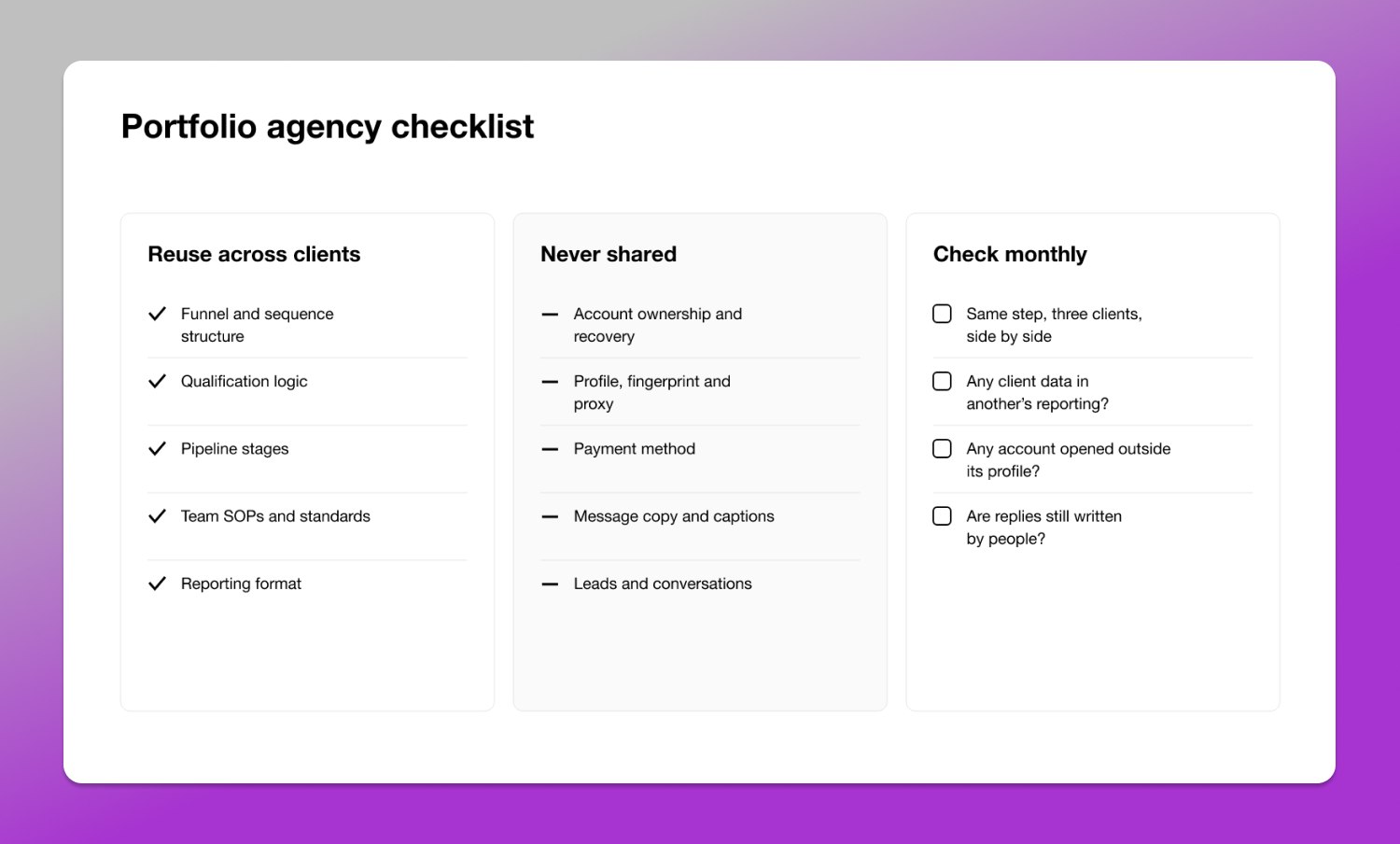
Reuse across every client:
- Funnel and sequence structure
- Qualification logic and pipeline stages
- Team SOPs and response standards
- Reporting format
Never shared between clients:
- Account ownership and recovery details
- Browser profile, fingerprint and proxy
- Payment method
- Message copy and captions
- Leads, conversations and pipeline data
Check monthly:
- Read the same sequence step across three clients side by side. Can you tell them apart?
- Is any client’s data visible inside another’s reporting?
- Has anyone opened a client account outside its own profile?
- Are replies still being written by people?
The short version
Niching down is the right move, and it creates the exact conditions that make a portfolio of accounts look coordinated: same audience, same offer, same rhythm, same words.
The way through is a clean split. Reuse everything nobody outside your team can see, which is the structure, the logic and the standards. Keep separate everything anyone can see or that belongs to the client, which is the identity, the copy and the data.
Do that and fifteen near-identical clients is a repeatable business. Skip it and it is fifteen accounts with one shared fate.