
Can I have multiple PayPal accounts? Yes, but only two, and only of specific kinds: one Personal account and one Business account, each registered to a different email address. Anything beyond that pair breaks the platform’s own rules. It is not a gray area that clever setup can soften, and PayPal’s rules treat it as a policy violation rather than an accident.
This guide is for people who qualify for both accounts: sellers, freelancers, and small businesses that need private money separate from customer money. You will find out who is entitled to the pair, how the two types differ, how PayPal decides that two accounts belong to the same person, what a limitation review involves, and how to keep two legitimate accounts from blurring into one confused session. One thing to fix first: PayPal’s User Agreement is regional. Rules, available features, and identification requirements differ depending on the country your account is registered in, so a US answer is not automatically a UK, EU, or Southeast Asian answer.
The Short Answer: One Personal Account Plus One Business Account
The rule fits in a sentence, and PayPal writes it in one: “You can have 1 Personal account and 1 Business account. Each account must be registered with a unique email address.”
What “distinct” means in practice:
- Separate email addresses. The same email cannot be the primary login for two accounts. That is a hard technical boundary, not a policy preference.
- Phone numbers. PayPal publishes no requirement for a separate number per account, which sets the phone apart from email, where uniqueness is stated outright. Treat a shared number as an association signal rather than a rule you can quote.
- Financial instruments have their own rules. A bank account or card generally cannot be attached to two live PayPal accounts at once, so plan the pair around separate funding sources from the start.
- Two is the ceiling for an individual. A third account, a “backup” account, or an account opened under a friend’s details is a violation regardless of how it is used.
There is an alternative most people never hear about. If the goal is simply to receive money at more than one email address, PayPal lets you add extra email addresses to a single existing account and receive payments to any of them. No maximum number of addresses per account is published, but the constraint that matters is: “When an email address is linked to a PayPal account, it identifies that account uniquely and cannot be added to any other PayPal account at the same time.” So the honest answer to “Can I set up a second PayPal account?” is often: you do not need one. You need a second email address on the account you already have.
Businesses running more than one PayPal account are a different case, and PayPal does have a feature for it: “If you operate your business using multiple PayPal accounts… you can now take advantage of our enterprise feature and link all your business accounts to manage them centrally.” What PayPal does not publish is who qualifies, how many accounts can be linked, or whether each one has to sit under its own registered legal entity. Do not plan around any of those as though they were stated.
Personal vs Business PayPal Account: What Actually Differs
The two account types are not tiers of the same product. They are built around different relationships.
A Personal account is for private money movement: paying for things online, splitting a bill, sending money to family, receiving the occasional refund. It is registered to a human being and verified against that person’s identity.
A Business account is registered to a trading name and built for taking money from customers you do not know. That brings a different toolset: invoicing, checkout integrations, subscription billing, multi-currency receiving, dispute and chargeback handling, refunds at scale, limited access for staff. It also brings a different fee model, since commercial transactions are priced differently from personal transfers and cross-border payments carry a currency conversion component. The rates themselves are set per country and revised on PayPal’s own schedule, so read them on the fee page for the country your account is registered in.
The difference people feel first is the name shown at checkout. A Personal account shows a person. A Business account shows the business, which matters when a stranger is deciding whether to hand over card details.
Who Legitimately Needs Both
Some concrete situations where the pair is the correct setup, not a workaround:
- A marketplace seller. Someone selling on Amazon, eBay, Etsy, or a Shopify store keeps store revenue in the Business account and personal transfers in the Personal account. Marketplace rules add their own layer: Amazon’s Seller Code of Conduct governs how many selling accounts a person may operate, which is a separate question from how many PayPal accounts they may hold.
- A freelancer taking cross-border payments. Client invoices land in the Business account, which produces clean records for an accountant and keeps foreign currency receipts in one place.
- A private individual who has just registered a business. The Personal account predates the company. The Business account is opened for the company. Both exist legitimately, because they represent two different parties.
The common thread is that the two accounts represent genuinely different economic activity. Where they represent the same activity, split in two to spread volume, the setup is a violation whatever the paperwork says.
Linking Your Personal and Business Accounts Inside PayPal
Most people who juggle two accounts do it the hard way: log out, log in, log out again. PayPal has a supported feature for exactly this. You can link a Personal and a Business account you own, and in PayPal’s words “you can switch between accounts instantly without logging out.” One condition attaches: you have to be the primary account holder of the business account.
This matters more than it sounds. Much of what gets people flagged is session confusion: the wrong account logged in at the wrong moment, two logins from one window, a password manager filling the wrong credentials. A platform-native switch removes that failure mode for the scenario it covers. Before reaching for external tooling, check whether the built-in feature already solves your case.
What Is a Verified PayPal Account, and Why Verification Is Not Optional
A verified PayPal account is one where PayPal has confirmed who you are and confirmed that the funding sources attached to the account belong to you. In practice that means proving identity, proving an address, and proving ownership of the linked bank account or card. Which documents are accepted, and what PayPal calls each state along the way, depends on the country the account is registered in, so follow the prompts inside your own account rather than a checklist copied from somewhere else.
For the user, verification turns a limited-function wallet into a working payment account. Until it is done, PayPal can keep parts of the account restricted, and which functions are affected depends on the country of registration. Your account’s own status page is the only accurate source for what currently applies to you.
For PayPal, verification is not a marketing funnel step. PayPal operates as a regulated payment institution in the markets it serves, which means it carries Know Your Customer and anti-money-laundering obligations imposed by financial regulators. Those obligations require the operator to know the identity behind every account and to reconstruct who moved what.
That is why “getting around verification” belongs in a different category from ordinary platform annoyances. Submitting someone else’s documents or building an account on details that are not yours is not an optimization. Depending on the jurisdiction it constitutes fraud or a money laundering offense, and the account is the least of what is at risk. This article does not describe how any of that is done, and no legitimate use case requires it.
Why PayPal Limits the Number of Accounts at All
The account cap looks arbitrary until you look at what PayPal is actually defending against.
Regulatory exposure. A payment operator must attribute transactions to identified people. Someone holding six accounts under thin variations of one identity destroys that attribution, which is the pattern AML rules exist to catch. Regulators fine operators for weak controls, so the operator writes strict rules.
Fraud and chargeback abuse. Multiple accounts are the standard mechanism for chargeback fraud, refund abuse, and triangulation schemes where stolen card details cycle through disposable seller accounts. Capping accounts per person makes those patterns expensive to run.
Enforcement that means something. If a limited account could be replaced in five minutes with a new signup, limitation would be a speed bump rather than a sanction. Account linking is what makes enforcement stick.
None of this is aimed at the freelancer with a Personal account and a shop. It is aimed at industrial-scale abuse, and the freelancer inherits the rules written for that.
How PayPal Links Accounts Together
PayPal does not disclose its detection logic, and anyone claiming to know the full list is guessing. What can be said without inventing anything is which data the platform necessarily holds, and it falls into two families.
Registration and financial data are the strongest ties, because they are the ones PayPal is legally required to collect: legal name, date of birth, residential address, national identification where applicable, phone number, email address, and above all the bank accounts and cards attached to the account. Two accounts funded by the same bank account are, from the operator’s point of view, the same economic person.
Technical signals sit on top of that: IP address, device and browser fingerprint characteristics, cookies and stored session data, login timing patterns. Weaker individually, stronger in combination.
This is where the questions people actually ask get their answers:
| Shared element | Where it stands |
| Same bank account on two accounts | Generally not permitted while both accounts are active. |
| Same debit or credit card on two accounts | The same restriction applies to cards. |
| Same phone number | Not addressed in PayPal’s published rules, unlike email. Treat a shared number as an association signal, not a stated violation. |
| Same legal name | Expected and permitted, since one person legitimately owns both accounts in the allowed pair. It is not a violation by itself. |
| Same email address | Not possible. Each account needs its own primary email login. |
| Same SSN or national ID | US accounts use the SSN or EIN for tax reporting; other countries use their own identifiers, so the requirement depends entirely on the country of the account. |
The pattern is consistent. Identity may repeat across the allowed pair, because it is the same person. Credentials and funding instruments may not.
What Happens If You Break the Rules: Limitation, Review, Holds
Enforcement usually arrives as a limitation. The account stays visible, but specific functions stop: sending, receiving, or withdrawing, in some combination. A notice appears explaining what is restricted and what PayPal wants.
From there the sequence runs limitation, then a review in which PayPal asks for supporting documents (identity documents, proof of address, invoices, supplier receipts, proof of delivery, or business registration papers depending on why the review opened), then an outcome. During the review, incoming funds can be placed on hold rather than released to your balance. PayPal does not publish one universal timetable for this; the notice in your account states what is being asked for and by when, and that notice is what governs your case.
Outcomes vary. Some limitations are lifted once documents check out. Some end in a permanent limitation, where the account is closed to further activity and remaining funds are handled under the terms of the User Agreement. There is no reliable way to predict which, and any service promising to lift a limitation, guarantee a successful appeal, or recover held funds is selling something it cannot deliver. The procedure is what it is: submit what is asked for, accurately, respond within the stated window, use the appeal channel PayPal provides if the outcome goes against you.
Opening a replacement account is not the answer, and it is expressly against the rules. If your account was limited or closed, creating a new one to continue trading is a further violation, and the linking signals described above are designed to catch exactly that. The new account is typically closed too, which makes recovering anything from the original harder rather than easier. The path that stays within the rules is the appeal process on the original account, and where the appeal fails and money is held, a lawyer or the relevant financial ombudsman in your jurisdiction.
The related question, “Can you make a new PayPal account if you already have one?”, has a cleaner answer: yes, if the new one is the other type and your first account is in good standing. A second account of the same type is not permitted.
How to Keep Your Two Allowed Accounts Properly Separated
If you legitimately hold both accounts, most of the risk you face is self-inflicted. Nothing here is about hiding from PayPal. It is about not looking like one tangled session to a system that reads sessions for a living.
Give each account its own email, and make them structurally different. Not name@ and name2@. A personal mailbox for the Personal account, a domain mailbox for the business.
Keep funding instruments separate. Personal card and personal bank on the Personal account. Business card and business bank on the Business account. Beyond the rules, mixing them creates the accounting mess your bookkeeper eventually has to unpick.
Do not run both accounts in the same browser window at the same time. Concurrent logins from one session are the most common way a clean setup starts looking suspicious. Use PayPal’s own account switching feature where it is available, or separate browser profiles where it is not.
Fix your password manager. Autofill picking the wrong credentials, then a failed login, then a correct login from the same window, produces exactly the log pattern a fraud system is tuned to notice. Store the two logins in distinct vault entries with strict account matching, and turn off silent autofill on the login page.
Do not share logins. If someone else needs access to the Business account, check what shared access PayPal’s help center describes for your account type and country, and grant it through that rather than by handing over a password. Passing a password around means every action looks like it came from you.
Keep the two money flows genuinely separate. Splitting one business’s revenue across two accounts to stay under a threshold or smooth out volume is exactly the behavior the rules target. If the money belongs to the business, it goes to the Business account.
Where Profile Isolation Is Appropriate, and Where It Is Not
Session isolation is a legitimate operational technique for some situations and a violation dressed in technical clothing in others. The line is straightforward: isolation organizes accounts you are entitled to hold. It does not create entitlement.
Appropriate:
- One person’s Personal and Business accounts, kept in separate working sessions so a mis-login never happens.
- An agency or account manager working on a client’s payment account under documented authorization, such as a delegated user seat or a written mandate, with the client’s knowledge.
- A freelancer with one working account and many client platforms, where the goal is a stable session and a readable login history rather than concealment.
- A small team where several people need access to one business account and the business wants a record of who logged in when.
Not appropriate:
- Registering a replacement account after a limitation or closure.
- Opening or operating an account on someone else’s identity, documents, or bank details.
- Any attempt to get past identity verification or KYC checks.
- Splitting one business’s turnover across several accounts.
- Presenting a browser tool as a way to avoid being linked. If two accounts must not be linked because linking would expose a rule violation, the problem is the violation.
If a described use case only works when PayPal fails to notice something, it belongs in the second list.
Team Practice: One Account, One Isolated Working Profile
For a team that manages payment accounts it is authorized to manage, the working rule is one account to one isolated browser profile. That is the pattern 🔥 Dolphin Anty is built around: separate working sessions for accounts you have the right to operate, with the session data for each account kept in its own container instead of pooled in one browser.
In practice, a profile holds its own cookie and local storage, its own set of fingerprint parameters (user agent and platform, screen and window geometry, timezone, language set, WebGL vendor and renderer, canvas and audio handling, hardware concurrency, and the rest), and its own network route. The proxy is attached per profile rather than system-wide, so one profile’s traffic goes out through its own route instead of a shared system connection. Teams working across markets usually bind a residential proxy in the account’s own country, because the route should match where the business actually operates rather than wander between regions from one session to the next.
Access control is the part that matters most for agencies. Team members get rights to specific profiles rather than to a shared password, so a contractor working on one client’s account cannot open another client’s, and access can be withdrawn when the engagement ends without rotating credentials everywhere. Setup details for creating profiles, attaching proxies, and assigning team permissions are covered in the Dolphin Anty documentation.
Dolphin Anty is a desktop application, available for Windows, macOS, and Linux. For current plan details and profile allowances, check the Dolphin Anty pricing page.
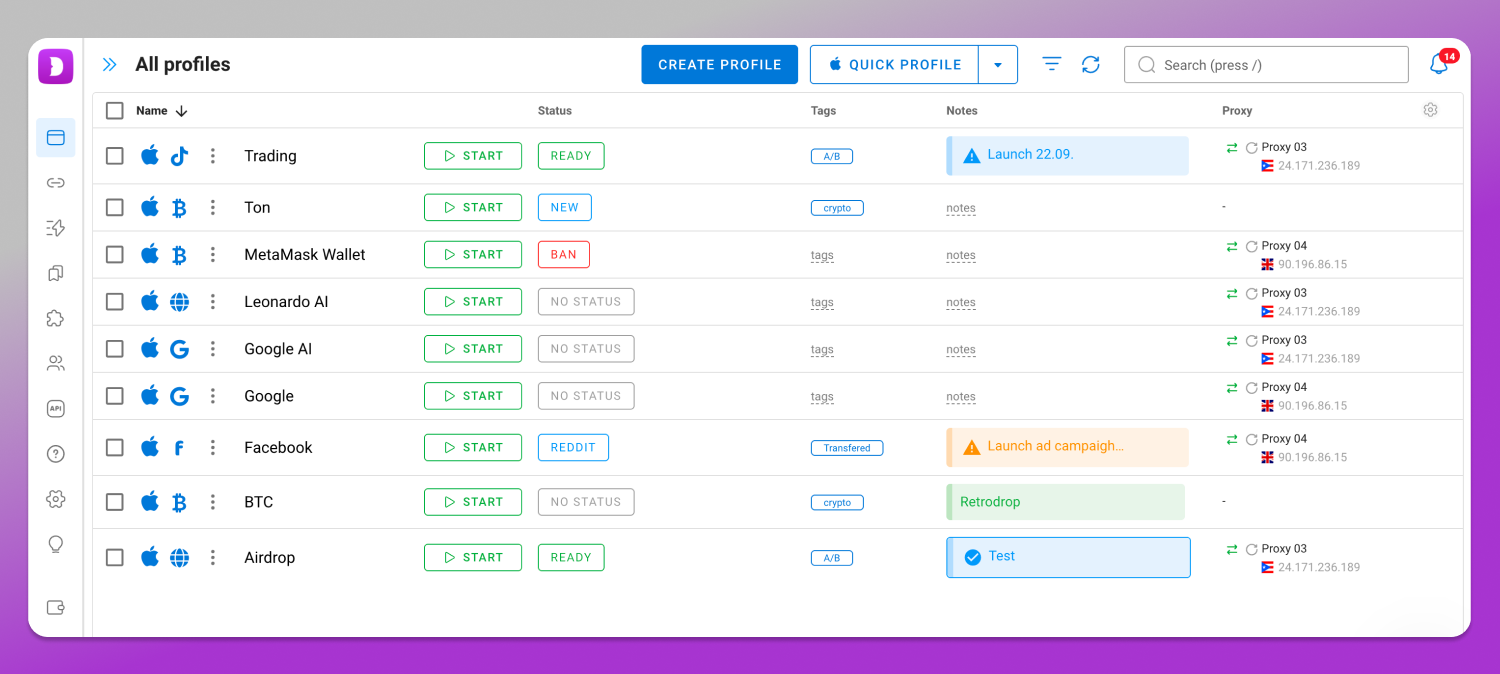
What this does not do: it does not let you hold more PayPal accounts than the rules permit, and it does not hide a rule violation from PayPal’s fraud systems. It keeps sessions that should be separate from becoming one confused session.
Compliance Note: This Is a Regulated Payment Account
Responsibility for following platform rules and the law sits with the account holder, not with any tool. Read the PayPal Acceptable Use Policy and the User Agreement for your account’s country, and if you sell on a marketplace, read its rules too: Amazon’s Seller Code of Conduct and its equivalents set their own account limits independently of PayPal.
Payment accounts carry an extra layer that ordinary logins do not. AML and KYC requirements come from financial regulators, not from PayPal’s product team, and working around them is a legal matter rather than a policy disagreement.
Data protection depends on where the people whose data you handle are located. GDPR applies to personal data of individuals in the EU. UK GDPR and the Data Protection Act apply in the United Kingdom. CCPA and CPRA apply to California residents, subject to the thresholds that determine which businesses are covered. Identify which framework applies to you instead of assuming one covers everything.
Nothing here is legal, tax, or accounting advice. Questions about how to structure turnover, which entity should hold which account, and what to declare belong with a qualified lawyer or accountant in your jurisdiction.
Frequently Asked Questions
Can I have two PayPal accounts with the same SSN?
The SSN question is US-specific. US accounts use a tax identifier (an SSN for individuals, an EIN for many registered businesses) for tax reporting, and the allowed pair belongs to one person. Other countries use their own identification requirements, so check what applies where the account is registered. Either way, the tax identifier is not what sets the number of accounts you may hold: one Personal plus one Business is the rule, and it does not change with the identifier you file under.
Can I have two PayPal accounts with the same phone number?
PayPal does not publish a rule requiring a different phone number for each account, which sets the phone apart from email, where the uniqueness requirement is explicit. What is fair to say is that the number is one of the identifiers PayPal can use to associate accounts, so a separate number per account is the cautious setup rather than a documented obligation.
Can you have two PayPal accounts with the same bank account or the same card?
Generally no. A bank account or card is normally tied to one PayPal account at a time, which is why the allowed pair needs two separate funding sources.
Can you have two PayPal accounts with the same name?
Yes. The allowed pair belongs to one person, so the same legal name appears on both. The name is not what causes problems. Shared credentials and shared funding instruments are.
Can I set up a second PayPal account?
Yes, if it is the other type and your existing account is in good standing: one Personal plus one Business, each with its own primary email login. Two accounts of the same type are not permitted, however different the registration details look. And if the reason is simply to receive money at another address, adding an extra email address to the account you already have solves it without a second account at all.
Can I open another PayPal account after my account was limited?
No. Opening a replacement account after a limitation or closure is prohibited, and the linking signals PayPal uses are designed for precisely that scenario. The route that stays within the rules is the review and appeal process on the original account: send the documents requested, send them accurately, meet the stated deadline. If the appeal fails and money is held, take it to a lawyer or your jurisdiction’s financial ombudsman rather than to a new signup form.
What to Do Next
The answer people arrive looking for is smaller than they expect. One Personal account, one Business account, different emails, different funding instruments. That is the whole allowance, and no configuration changes it.
The real work is not getting around a limit. It is making sure your two permitted accounts never look like one tangled session: the right email on the right account, the business bank on the business account, no simultaneous logins from one window, no shared passwords across a team. Start by checking whether PayPal’s own account linking feature covers your switching needs. If your team handles authorized accounts across several clients or markets and needs isolated sessions with real access control, look at what Dolphin Anty offers on Windows, macOS, or Linux, and check the current plans on the 🚀 Dolphin Anty pricing page.