From the outside, 📉 scaling multi-account operations often appears to revolve around familiar variables: account quality, tool selection, launch speed, or simply the number of people involved in maintaining workflows. At smaller scales, this assumption usually feels reasonable because when operations rely on a few dozen accounts, inefficiencies often remain manageable through manual intervention, additional checks, or the accumulated experience of operators who understand systems well enough to compensate for inconsistencies before they become visible.
However, if we look at how larger teams operate today — whether in affiliate marketing, automation, hypothesis testing, multi-geo campaigns, or complex operational systems involving hundreds of moving parts — a different pattern gradually emerges. At some point, accounts stop being the primary limitation, while the environment surrounding those accounts increasingly determines whether systems remain predictable months after another stage of growth has already taken place.
The most interesting aspect of this transition is that it rarely happens abruptly. Teams almost never wake up one day and conclude that infrastructure has become their biggest problem. Instead, the process unfolds gradually. Manual checks become more frequent. Internal documentation expands. New employees require longer onboarding periods. Technical questions that used to be solved once start reappearing repeatedly. Months later, many teams eventually recognize that complexity increased not because volumes became larger, but because the entire system gradually became less predictable.
Why the Market Started Looking at Scaling Differently
Several years ago, multi-account operations across many industries were considerably simpler because most teams managed a relatively limited number of simultaneous processes, while platforms themselves tended to be less sensitive to environmental consistency. Even when operational chaos existed beneath the surface, experienced operators often compensated for it through additional manual work or accumulated knowledge.
Today, the situation looks different, and it is increasingly interesting to observe how perceptions of scaling continue changing alongside growing operational complexity. Teams simultaneously operate across multiple geo, dozens of launch scenarios, automation layers, distributed employees, and continuously changing platform requirements, while decision-making speed has evolved from a competitive advantage into something much closer to an operational survival factor.
Growth used to be frequently 📈 associated with increasing the number of accounts or launches. Today, many mature teams evaluate entirely different metrics instead: how long onboarding requires before new employees become effective, how predictable results remain under identical conditions, how many workflows continue depending on specific individuals, and how quickly new team members can reproduce existing processes without constant support.
This shift happens because such variables often begin limiting growth much earlier than teams expect, sometimes long before they exhaust available tools or account volumes.
Under these conditions, an💡 important change occurs: efficiency becomes less dependent on how many accounts teams manage and increasingly influenced by how predictable everything surrounding those accounts remains over time. Problems rarely originate from one specific tool. More often, they emerge through the accumulation of smaller inconsistencies: workflows continue relying on manual intervention, environments gradually diverge from one another, new employees interpret instructions differently, and maintenance requirements increase almost unnoticed.
Individually, none of these factors appears particularly serious, which is precisely why many teams continue scaling without recognizing that hidden operational friction has already started accumulating beneath visible growth.
Why Teams Usually Notice Problems Too Late
One of the defining characteristics of infrastructure-related limitations is that they rarely resemble obvious failures.
No team receives a notification saying:
“Your operational efficiency has decreased.”
Reality tends to look much more ordinary.
A new employee who previously required two days to adapt suddenly needs a week because parts of the documentation became outdated while other processes exist only in the experience of one person. Launches that once required an hour gradually require three because additional checks become standard practice. Teams slowly become accustomed to manually reviewing outcomes, while small differences between working environments begin feeling normal.
Many organizations stop noticing these changes precisely because they happen gradually. Losing ten minutes inside one process appears insignificant. However, when dozens of launches run simultaneously, those delays begin forming an additional operational layer capable of consuming hours every week without attracting immediate attention.
Several months later, the situation starts affecting the rhythm of the entire team. Processes requiring hours begin requiring multiple approvals. New employees take longer to become productive because hidden dependencies continue accumulating. The most frustrating aspect is that these limitations almost never resemble major problems.
Usually, they appear as dozens of minor complications gradually transforming into permanent operational noise.
This partly explains why experienced teams increasingly evaluate efficiency through less exciting metrics, including onboarding duration, result consistency under identical conditions, the number of manual actions required for standard workflows, and how many critical processes continue depending on knowledge held by individual employees.
In many cases, those variables eventually determine whether further growth remains possible.
How to Recognize That a Team Has Already Reached Infrastructure Limitations
Several indicators tend to appear before serious operational issues emerge:
| Symptom | What often causes it |
| New employees require long onboarding | Too many hidden manual processes |
| Results become less repeatable | Differences between working environments |
| Launches gradually require more time | Increasing verification layers |
| Teams constantly fix minor issues | Accumulating operational noise |
| More accounts do not accelerate results | Infrastructure stopped scaling |
Interestingly, stronger teams often begin changing their approach before major failures occur, specifically when they notice increasing amounts of time being spent maintaining existing systems rather than improving them.
Why More Accounts Do Not Always Mean More Growth
There is an interesting paradox many teams only notice after months of scaling.
Imagine a team increasing active operations from 100 to 300 accounts. Logically, one might expect output to grow proportionally.
📌 Reality often looks different.
The number of launches increases. More employees join. More tools become involved. At the same time, however, maintaining existing systems starts requiring additional resources. More checks appear. Internal documentation expands. More time becomes necessary to explain workflows to new participants.
Eventually, teams realize additional resources are no longer accelerating growth but compensating for accumulated complexity.
This does not mean scaling stops working. Rather, scaling starts requiring a different way of thinking.
Mature teams gradually shift from asking:
“How do we launch more?”
to asking:
“How do we increase volume without destroying process predictability?”
At that stage, infrastructure slowly stops being a technical detail and begins becoming a competitive advantage.
How Mature Teams Eventually Start Thinking Differently
One of the more interesting shifts becomes visible not through tools or infrastructure choices but through the kinds of questions teams begin asking themselves over time.
At earlier stages, growth is often associated with increasing account volume as quickly as possible. Questions tend to sound practical and immediate:
“How do we launch more?”
“How do we accelerate execution?”
“How do we increase output?”
As operational complexity accumulates, however, many mature teams gradually discover that maintaining predictable systems becomes more important than increasing volume alone.
The questions start changing.
Instead of focusing exclusively on launch speed, teams increasingly ask:
“How do we ensure processes remain repeatable six months from now?”
“How quickly can new employees reproduce existing workflows?”
“Would operations continue functioning if several experienced operators left simultaneously?”
At first glance, those shifts may appear subtle.
In practice, they often indicate a transition from thinking about accounts individually toward thinking in systems.
That difference matters because systems capable of producing similar outcomes regardless of who operates them tend to remain scalable much longer than systems dependent on accumulated experience held by specific individuals.
This is one reason many experienced operators eventually describe scaling differently.
At smaller scales, growth often feels like expansion.
At larger scales, growth increasingly starts resembling maintenance unless operational environments remain sufficiently predictable.
Why Small Operational Delays Eventually Become Strategic Problems
There is another pattern experienced teams frequently notice only after months of scaling.
☝️ Small delays rarely remain small.
An additional verification step requiring ten minutes may initially seem insignificant. A workflow becoming slightly harder to reproduce may not attract immediate attention. Onboarding extending by several days rarely appears alarming.
Individually, those changes often feel manageable.
Collectively, however, they gradually begin influencing the rhythm of the entire organization.
Teams that previously launched quickly become slower. Decisions require additional approvals. Documentation expands. Existing operators spend increasing amounts of time supporting others instead of improving systems.
At some point, organizations discover an uncomfortable reality:
Growth itself has not necessarily become more difficult.
Maintaining growth has.
This distinction is important because mature teams increasingly optimize not only for expansion but also for preserving predictability while complexity continues accumulating.
Why Infrastructure Is Gradually Becoming a Competitive Advantage
If teams managing hundreds of accounts were asked what unexpectedly became their biggest limitation, many would rarely mention accounts themselves. More often, they would refer to factors initially perceived as secondary: environmental consistency, workflow repeatability, onboarding speed, or the ability to reproduce identical scenarios without constant manual intervention.
This explains why increasing numbers of teams evaluate not only tools but also the infrastructure surrounding them, including automation systems, working environments, and connection layers.
For example, services such as Proxies.sx are increasingly viewed as components of stable long-term environments for multi-account operations because AI-native 4G/5G mobile proxy infrastructure built on real devices and carrier SIM cards becomes more relevant when teams prioritize repeatability, automation, and simultaneous work across multiple geo.
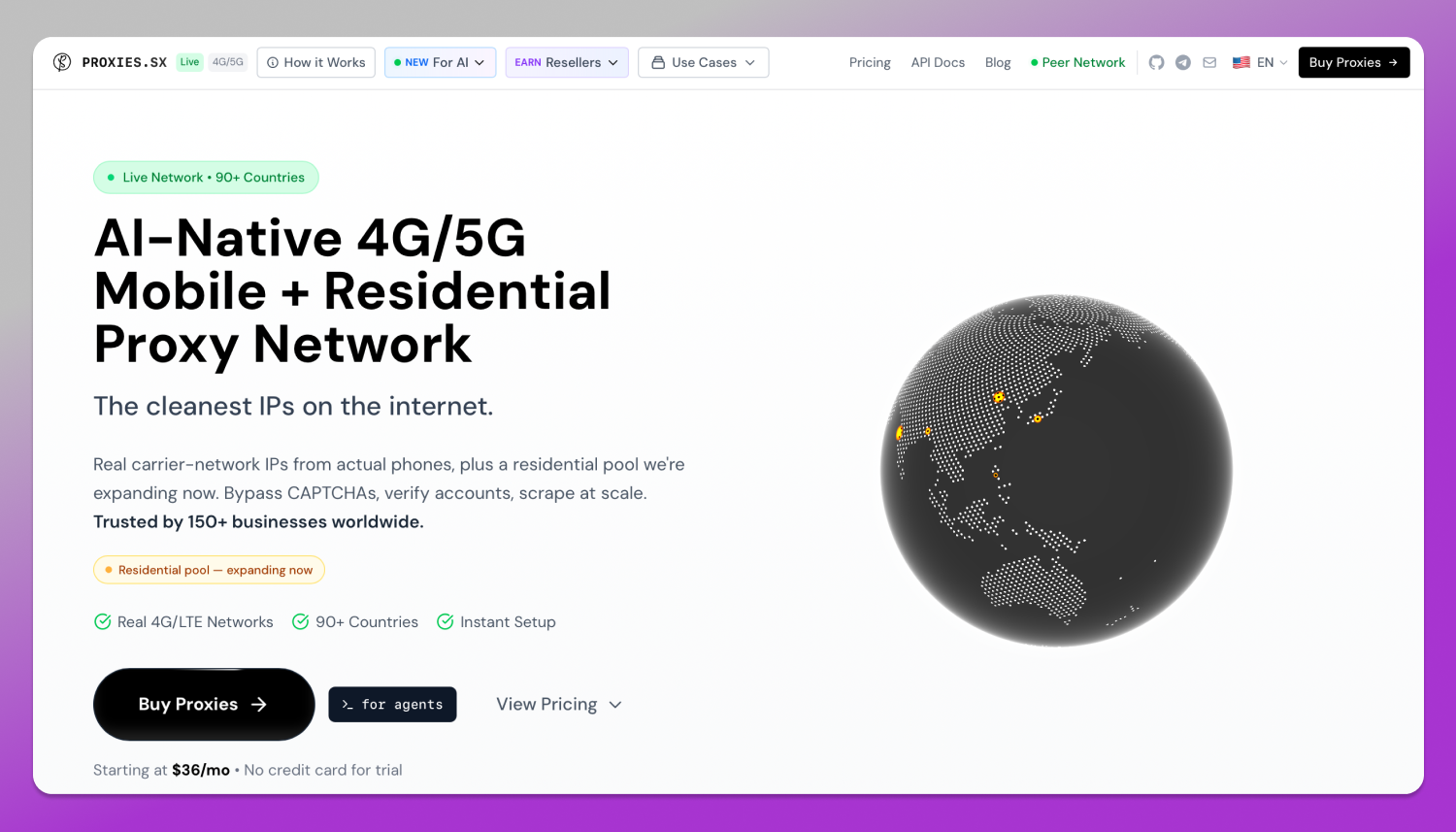
New users can currently use:
WELCOME15 — 15% off the first order
The more important observation, however, is that mature teams increasingly evaluate such solutions not as isolated tools but as elements inside larger systems expected to remain stable long after scaling begins.
FAQ
Why do teams managing larger account volumes gradually start thinking more about environments than accounts?
Because as operations grow, small inconsistencies tend to accumulate and eventually become operational costs affecting onboarding, predictability, maintenance, and long-term scalability. Many mature teams discover that growth limitations often emerge from environments rather than account volume itself.
At what point do infrastructure-related problems usually become visible?
There is no universal threshold, but many teams begin noticing these patterns somewhere between dozens and hundreds of active processes, particularly when onboarding becomes slower, workflows become harder to reproduce, and maintenance starts competing with growth.
Why can identical workflows produce different outcomes inside one team?
Because environments rarely consist of one variable. Small differences in browser setups, connection layers, undocumented habits, workflow interpretation, and accumulated changes gradually influence results.
Can teams scale quickly while maintaining stable operations?
Yes, although this usually requires treating infrastructure as part of operational strategy rather than a collection of separate tools.
What distinguishes mature multi-account operations from smaller teams?
Smaller teams often compensate through experience and manual intervention. Mature teams increasingly rely on systems capable of producing predictable outcomes regardless of who operates them.
Conclusion
Perhaps one of the most unexpected realizations teams encounter after operating at larger scales is that limitations slowing growth rarely emerge where they originally expected to find them.
More often, constraints appear gradually through additional checks, accumulated operational noise, slower launches, increasing onboarding complexity, fragmented environments, and growing dependence on manual intervention. Teams usually recognize these changes too late, often when systems technically continue functioning but already require significantly greater effort to preserve previous speed.
This is precisely why mature teams eventually stop viewing scaling as the process of increasing account volume and begin treating it as the ability to create predictable environments where growth does not gradually transform into continuous resistance against complexity.
Many operators discover something counterintuitive only after working with larger volumes:
The biggest limitations often were never related to accounts themselves.
They emerged from everything surrounding those accounts — environments, workflows, repeatability, onboarding, infrastructure consistency, and the ability to preserve predictable outcomes while complexity continued growing in the background.
And sometimes, the most valuable competitive advantage is not the ability to launch more processes.
It is the ability to maintain stability while scale quietly continues increasing.