
How to Increase Trading Volume Without Getting Banned
Today cryptocurrencies can be bought and sold across multiple exchanges, while trading conditions vary depending on the country, supply/demand and available payment methods. As a result, the price of the same asset can differ across different markets. In some cases, this price gap can generate a profit even after paying all trading fees. This is the basis of crypto arbitrage: buying an asset at a lower price and selling it at a higher price.
What Is Crypto Arbitrage?
🔄 Cryptocurrency arbitrage is a trading strategy that allows traders to profit from price differences for the same asset. Depending on where the price gap occurs, there are three main types of arbitrage:
- Intra-exchange arbitrage – trading between different trading pairs on the same platform. For example, the price of an asset in one pair may differ from its value calculated through another pair.
- Cross-exchange arbitrage – buying an asset on Exchange A at a lower price and selling it on Exchange B at a higher price.
- P2P arbitrage – buying cryptocurrency from another user through P2P at a lower price and then selling it at a higher price.
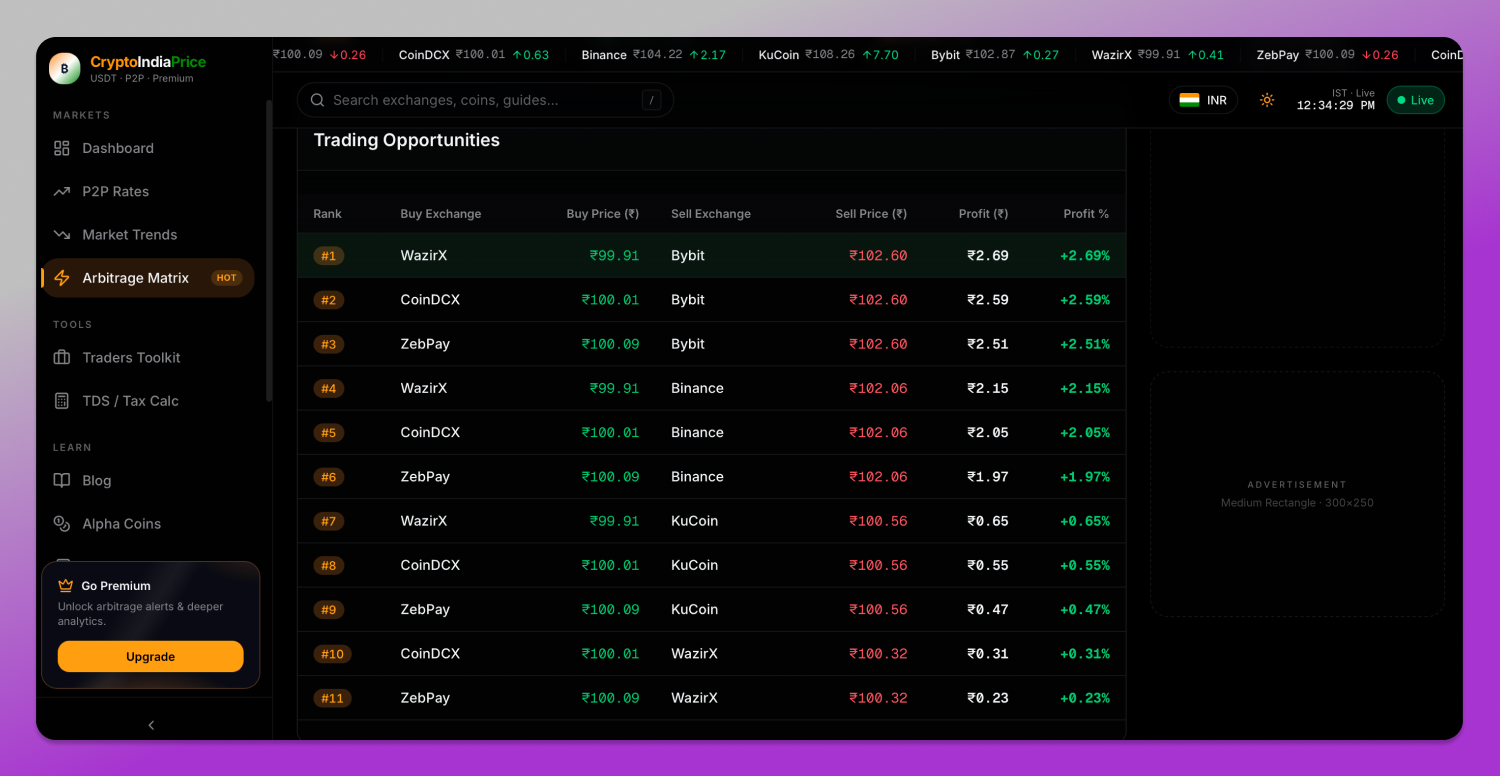
As shown in the screenshot above, platforms offer 📈 different rates for buying and selling cryptocurrency. The data is presented in a table, so you don’t have to compare all the exchanges manually.
Why Is Arbitrage Possible at All?
Cryptocurrency does not trade at a single global rate. The price is set on each platform and in each geo based on real supply and demand, which can vary significantly. National regulations, available payment methods and banking restrictions also affect the price.
For example, in one country or on one exchange, high demand for USDT may lead buyers to pay more for it. In another country, a large supply may push the price lower. But to profit from the price difference, you need to 🧮 calculate the entire chain of costs (using cross-exchange crypto arbitrage across different countries as an example):
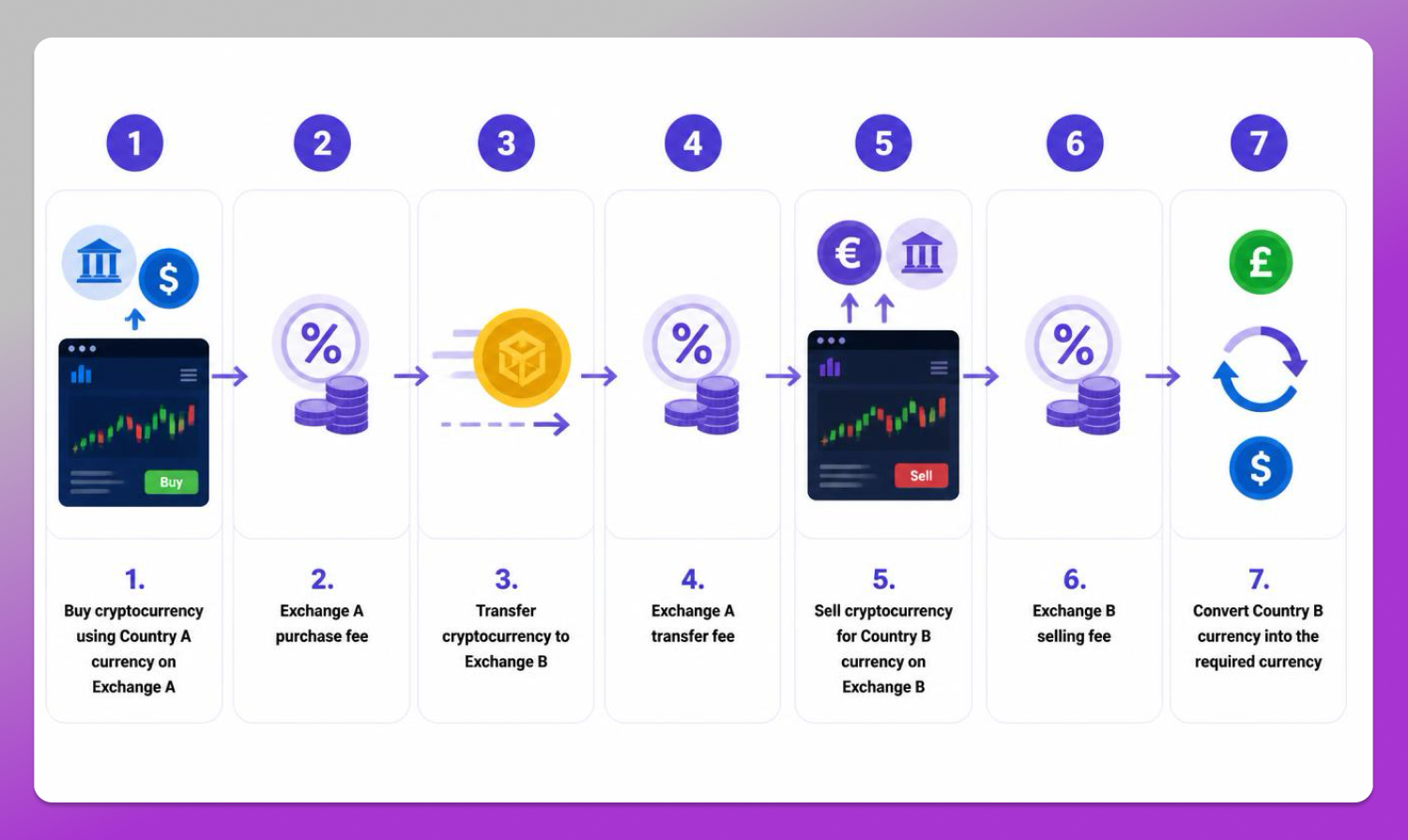
In addition, there are other associated costs, such as 💳 virtual cards for the required jurisdiction. These also need to be taken into account.
A trader looks for price discrepancies that allow them to make a profit even after all fees are factored in. Special software is often used for this, automatically executing a trade when a certain price is reached.
Account Restrictions
Verification requirements on crypto exchanges 👨⚖️ are constantly becoming stricter at the regulatory level. Major platforms no longer provide full access to trading and deposits without identity verification. For example, Binance and Bybit require KYC verification to access all of their products and services.
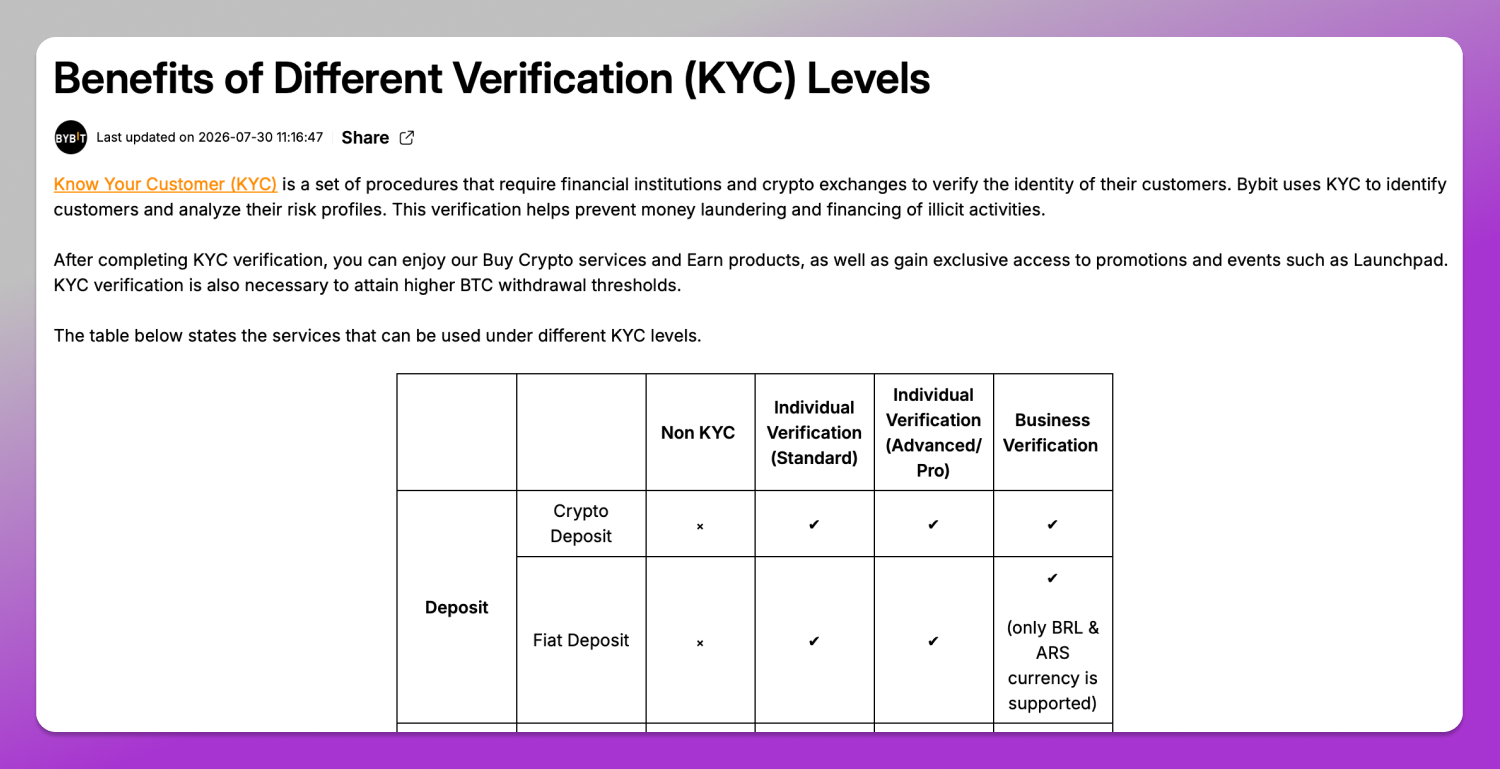
Requirements are even stricter for fiat transactions. To deposit and withdraw local currencies, buy cryptocurrency with bank cards and perform other fiat-related operations, exchanges require 🔎 identity verification and, in some cases, 📁 additional documents, such as proof of residential address.
At the same time, there are still platforms with more flexible requirements for crypto-only trading. For example, CoinEx allows users to trade on the spot and futures markets without verification. Unverified accounts have a withdrawal limit of up to $10,000 per day and $50,000 per 30 days. However, P2P and fiat transactions require account verification.
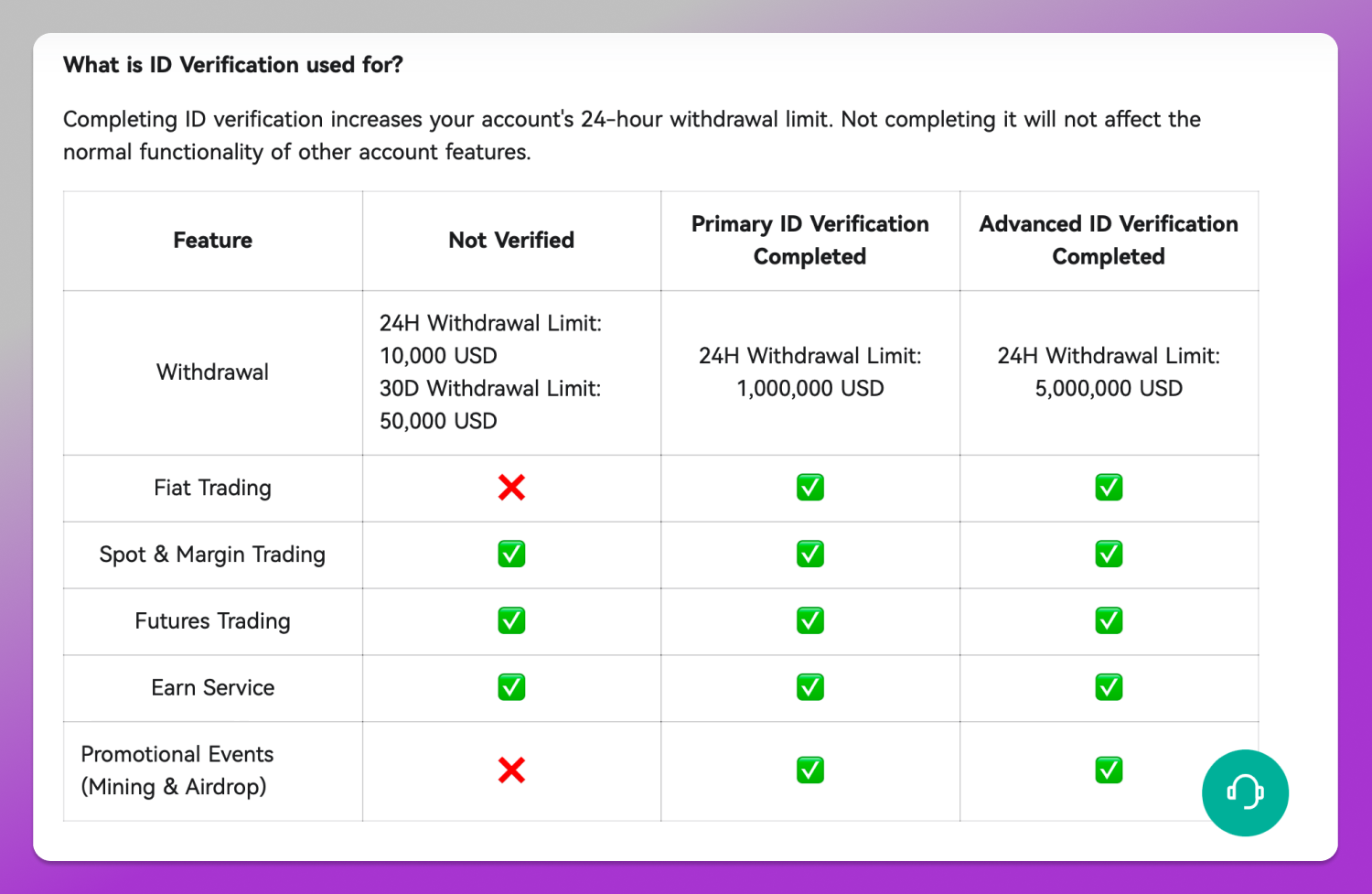
This leaves two different scenarios. If a trader works with fiat and P2P, KYC becomes mandatory. If transactions are limited to crypto-to-crypto pairs, it is still possible to find exchanges without mandatory verification, although the limits and available features will be significantly more restricted.
How Multiple Profiles Help Minimize Risks
Multiaccounting does not eliminate KYC or allow users to bypass mandatory identity verification. However, having multiple accounts allows traders to increase their overall trading volume and distribute it across accounts. This is especially relevant to the second scenario – trading cryptocurrencies without KYC. At the same time, multiaccounting rules should be checked for each platform individually, as it can result in a ban.
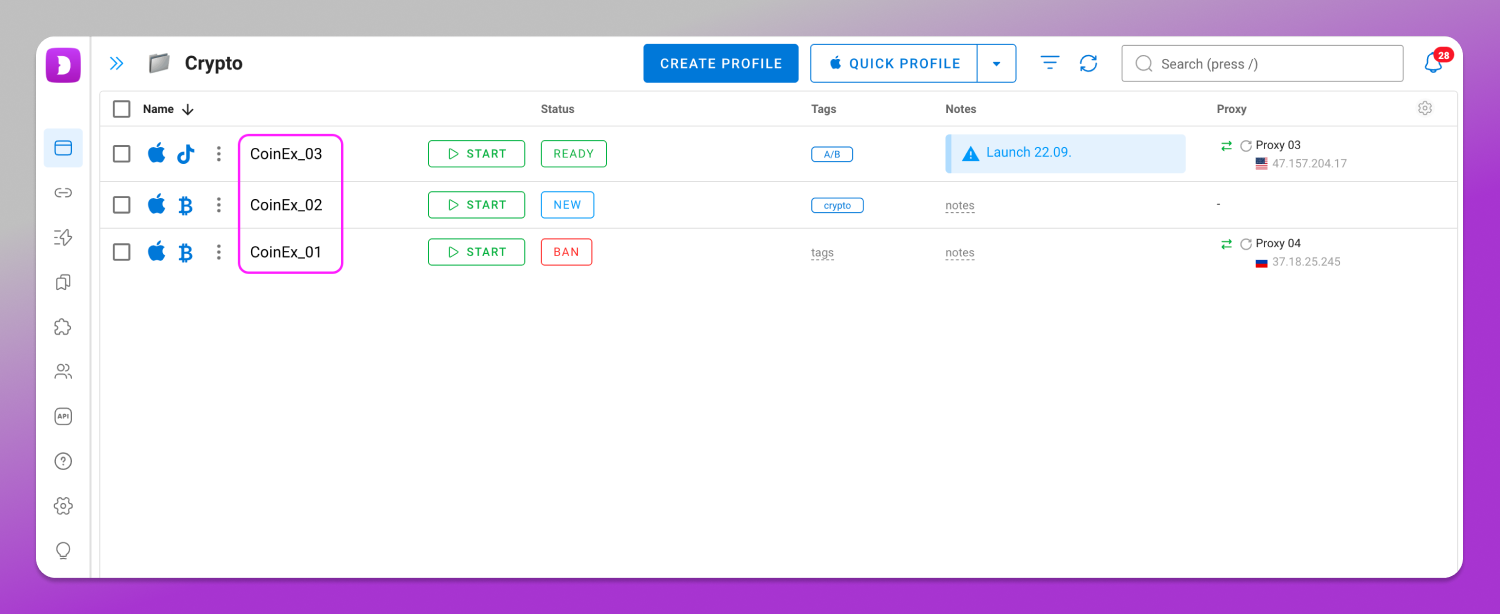
Different browser profiles are also useful when a trader works with several exchanges at once. Instead of keeping all accounts in the same browser, they can be separated into individual profiles and configured for each platform.
It is important that the proxy geo matches the exact region the account is registered for, rather than simply being “similar”. For example, if a P2P account is created for the Indian market while the proxy is European, the exchange will see a mismatch between the declared location and the actual IP address, which can trigger an additional verification. The same applies to the interface language and time zone: if an account “lives” in Brazil while the browser is set to English with UTC+3, that is another inconsistency that any security algorithm can easily detect. That is why a profile should be configured as a single set of parameters for a specific geo, from the proxy to the language and time zone.
What Else to Consider in Crypto Arbitrage
Besides KYC, there are several other important factors to consider. Different platforms may have different requirements for documents, available payment methods, withdrawals and multiaccounting.
👨⚖️ Regulatory requirements. Cryptocurrency regulations vary from country to country. Pay particular attention to provisions covering fiat currencies and P2P transactions, as they may be subject to additional requirements from banks, payment systems, and regulators.
💸 AML. KYC has already become a standard requirement for most major cryptocurrency exchanges, especially when dealing with fiat and P2P. Identity verification allows a platform to identify users and monitor their transactions in accordance with AML requirements.
🧱 Platform reliability. Before transferring funds, it is worth assessing an exchange’s reputation, track record, available withdrawal methods, and account suspension policies. This is especially important for trading: if a platform suspends withdrawals or introduces additional checks while a trade is in progress, the spread between markets may no longer be viable.
🤏 Fees and limits. The spread between two platforms does not equal profit. You need to deduct fees for buying and selling, cryptocurrency withdrawals, possible currency conversions and other expenses. You should also check trading limits in advance to make sure the required trade volume can actually be executed.
😎 P2P fraud. When working with crypto P2P arbitrage, there is a risk of dealing with an unreliable counterparty. For example, a buyer may send fake payment confirmation, use a payment from a third party or attempt to reverse a transfer after receiving the cryptocurrency. That is why it is important to verify that the funds have actually arrived directly in your banking app or payment system.
Therefore, before each trade, it is important to check the exchanges’ rules, fees, verification requirements and legal restrictions. When dealing with other users, you should also account for fraud risks, P2P exchange limits, and transaction rules.
Is Multiaccounting Necessary for Crypto Arbitrage?
KYC significantly limits the ability to create a large number of accounts on cryptocurrency exchanges. However, if a particular platform does not require immediate verification, the antidetect browser 🚀 Dolphin Anty can help increase the overall available trading volume as it allows you to create profiles with their own digital fingerprints.
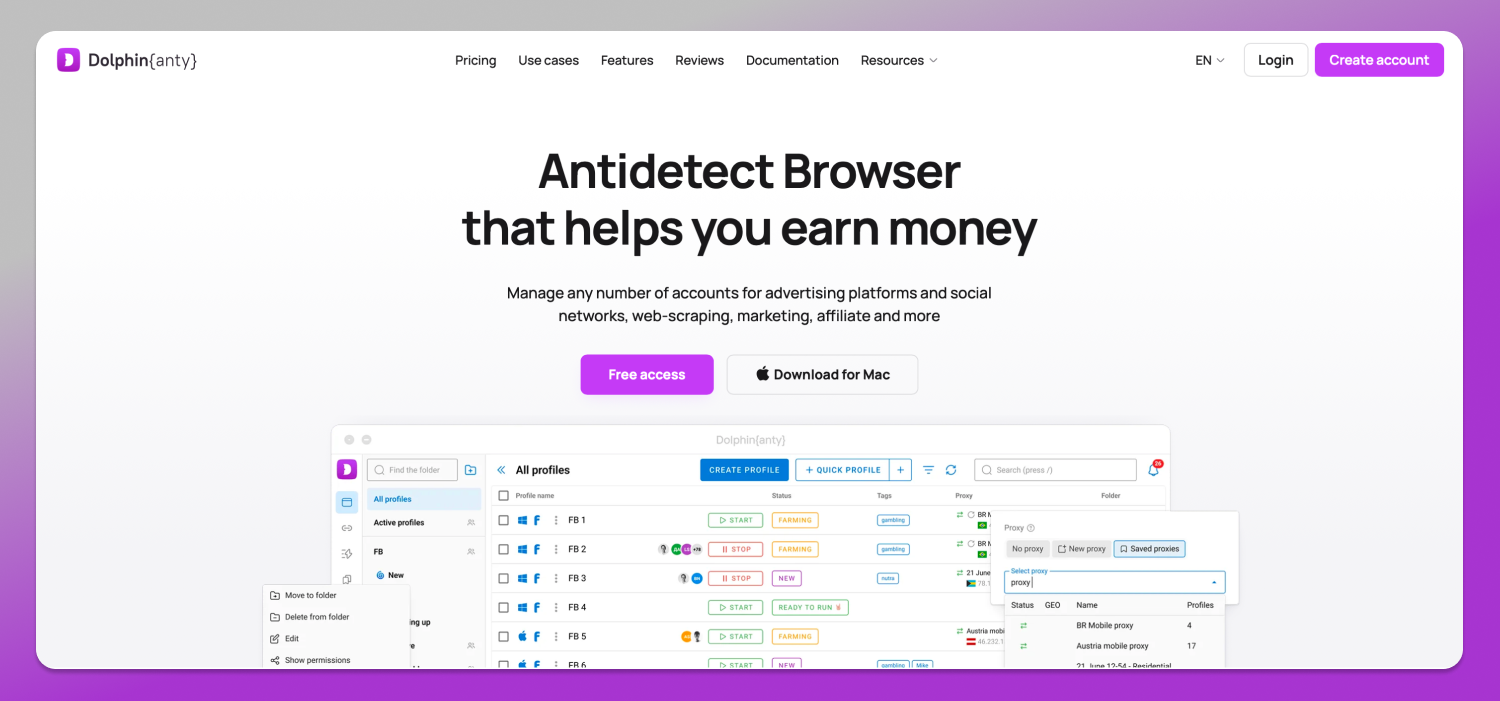
At the same time, a separate digital fingerprint does not guarantee protection from a ban. Exchanges analyze not only the browser’s technical parameters, but also account behavior, transaction history and other signals. So much depends on how the account is actually used. Separating accounts means you don’t have to keep all your crypto in one place and helps minimize losses caused by an account being blocked.
An anti-detect browser for crypto trading also makes day-to-day work with multiple accounts more convenient. Operations can be organized by project, geo or direction, while each exchange can have its own profile with the required extensions, bookmarks and start pages. You can discuss setup, working with crypto, and other topics in the 🙋♂️ Dolphin Anty community chat.